Digital Transformation
Top AI News for February 2026: Breakthroughs, Launches & Trends You Can’t Miss
February 2026 AI roundup: multimodal and agentic breakthroughs, trillion-parameter models, digital twins, and falling inference costs reshaping enterprise adoption.

Top AI News for February 2026: Breakthroughs, Launches & Trends You Can’t Miss
- Autonomous AI agents are transforming industries, handling tasks without constant human input. The FDA’s “Elsa” and Hertz’s use of Amazon’s Nova Act are prime examples.
- Multimodal AI tools now process text, images, video, and audio simultaneously, boosting efficiency in marketing, education, and automation.
- Moonshot AI’s Kimi K2.5 launched with 1-trillion parameters, enabling faster task execution through its “Agent Swarm” feature and advanced coding capabilities.
- Alibaba’s Qwen3-Max-Thinking excels in reasoning, math, and coding, with adaptive tools for real-time data use and open-weight access for developers.
- Agentic AI is optimizing workflows in manufacturing, energy, and infrastructure, reducing delays and improving reliability.
- Digital twins are improving forecasting and maintenance in energy and manufacturing, cutting costs and compute time.
Key Stats:
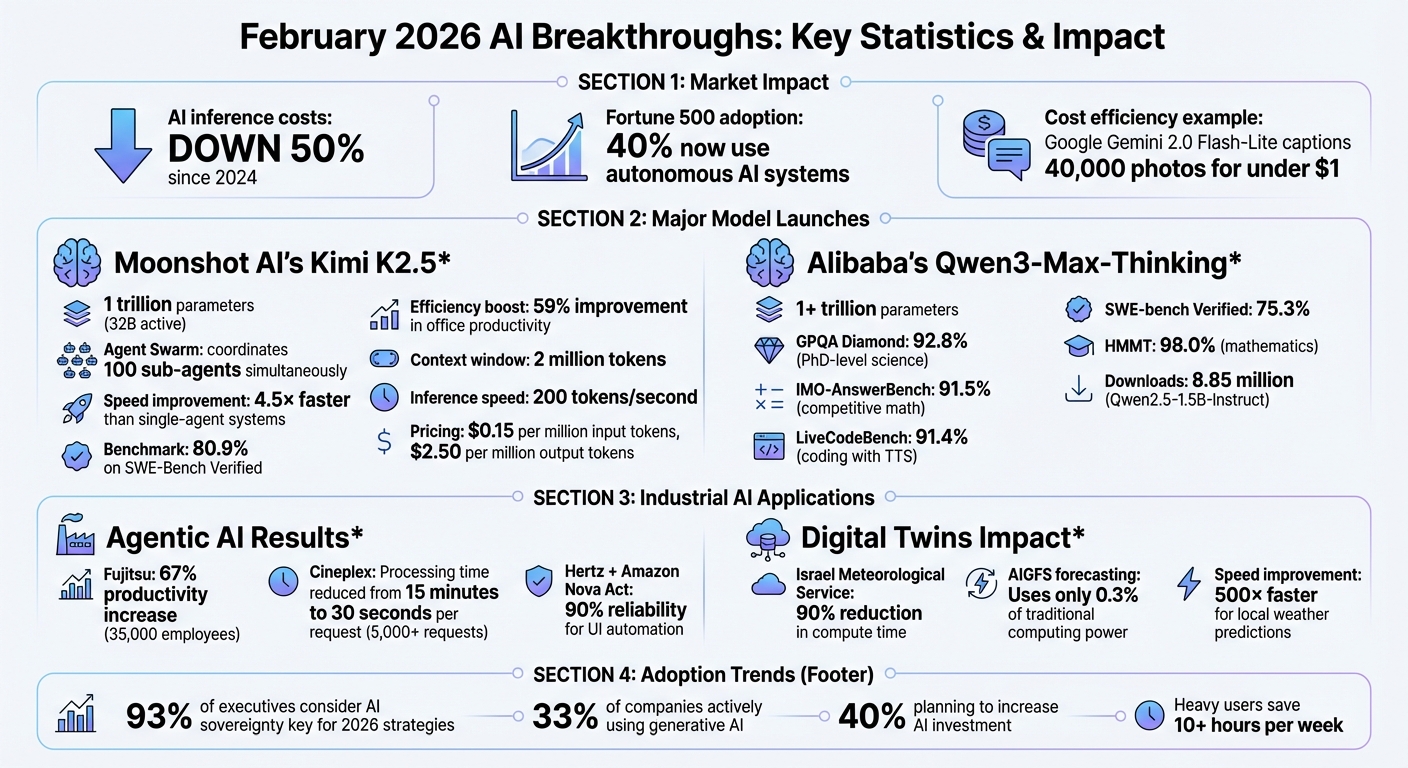
- AI inference costs have dropped by 50% since 2024.
- Over 40% of Fortune 500 companies now use autonomous AI systems.
- AI tools like Google’s Gemini 2.0 Flash-Lite can caption 40,000 photos for under $1.
These advancements are reshaping industries, making AI tools more efficient, affordable, and accessible than ever before.
February 2026 AI Industry Statistics and Key Breakthroughs
AI News: Tues Feb 01, 2026 - Tech 1 - OpenClaw: The Mini-Series & Google's Project Genie is Awesome
sbb-itb-212c9ea
Moonshot AI's Kimi K2.5 Launch
On January 27, 2026, Moonshot AI introduced Kimi K2.5, a game-changer in visual content processing and workflow automation. This model boasts a massive 1-trillion parameters, with 32 billion active parameters trained on a dataset of 15 trillion mixed vision and text tokens. It can seamlessly handle text, images, and video, all in one system.
One of its standout features is Agent Swarm, which allows Kimi K2.5 to coordinate up to 100 specialized sub-agents simultaneously. This capability slashes execution times for large-scale tasks by an impressive 4.5× compared to traditional single-agent systems, transforming hours of work into mere minutes.
For creative professionals, the Coding with Vision feature is a game-changer. It can analyze video content and static images to generate functional frontend code by observing website interactions and reconstructing the underlying logic, styling, and animations. Beyond creative tasks, Kimi K2.5 enhances office productivity by automating tasks with AI automation tools like generating professional documents, building financial models in Excel, and creating presentation slides - all with a 59% efficiency boost compared to its predecessor.
On technical benchmarks, Kimi K2.5 scored 80.9% on SWE‑Bench Verified and 75% on MMMU Pro, placing it among the top open models. Artificial Analysis praised its performance, stating:
"Kimi K2.5 is the new leading open weights model, now closer than ever to the frontier - with only OpenAI, Anthropic and Google models ahead".
Main Features of Kimi K2.5
Here’s a closer look at what makes Kimi K2.5 so powerful:
Kimi K2.5 operates in four modes tailored to different tasks:
- Instant mode: Provides quick responses for straightforward queries.
- Thinking mode: Tackles complex problems with deep reasoning.
- Agent mode: Generates structured outputs like spreadsheets or presentations.
- Agent Swarm mode: Coordinates up to 1,500 steps across 100 sub-agents for large-scale, concurrent tasks.
Its visual debugging feature, accessible via the "Kimi Code" tool, is a major asset for developers. It allows the model to review its own outputs, identify UI/UX issues, and resolve them autonomously. This is integrated with IDEs like VSCode and Cursor, enabling smooth transitions from design mockups to deployable prototypes. Researchers can also use Agent Swarm mode to profile hundreds of leads or analyze large datasets in parallel.
Kimi K2.5’s ultra-long context window, capable of handling up to 2 million tokens, makes it ideal for analyzing extensive documents like product catalogs, legal contracts, or academic research without losing context. Running on the Fireworks.ai platform, it delivers inference speeds of up to 200 tokens per second.
The pricing structure is flexible, offering free access under general limits and paid tiers - Moderato, Allegretto, Vivace - for higher thresholds and faster hardware. API pricing starts at $0.15 per million input tokens and $2.50 per million output tokens. Running the Artificial Analysis Intelligence Index on Kimi K2.5 costs around $371, making it over four times cheaper than Claude Opus 4.5.
These features highlight why Kimi K2.5 is reshaping the AI landscape in February 2026.
How Kimi K2.5 Compares to AI Apps Directory Tools
Kimi K2.5 doesn’t just push boundaries - it redefines industry standards. Here’s how it stacks up against traditional video and agent tools:
| Feature | Kimi K2.5 | AI Video/Agent Tools (Directory) |
|---|---|---|
| Primary Function | Multimodal Reasoning & Agent Swarm | Video Generation/Editing or Single‑Task Automation |
| Input Support | Text, Image, Video (Native) | Typically Text‑to‑Video Only |
| Task Execution | Up to 100 Parallel Sub‑Agents | Usually Sequential or Single‑Agent |
| Coding Capability | Video‑to‑Code (Frontend) | Mostly Text‑to‑Code or None |
| Office Integration | Native Word, Excel, PDF, Slides | Often Requires Third‑Party Plugins |
| Benchmark Performance | 80.9% (SWE‑Bench Verified) | Varies by Tool |
| Pricing Model | Usage‑Based API & Tiered Subscriptions | Monthly SaaS Subscriptions |
| Verification Status | Open Weights / SOTA Benchmarks | Varies by Directory Listing Status |
For businesses seeking to compare tools, the AI Apps directory offers a centralized platform to evaluate pricing, features, and verification statuses through both featured and free listings.
Alibaba's Qwen3-Max-Thinking: Advanced AI Reasoning
In early 2026, Alibaba introduced Qwen3-Max-Thinking, a reasoning model with over 1 trillion parameters built to handle challenges like PhD-level science, competitive mathematics, and complex software engineering tasks. A key feature of this model is Experience-Cumulative Test-Time Scaling (TTS), which allows it to refine its answers by learning from earlier reasoning attempts.
Qwen3-Max-Thinking has demonstrated impressive performance across various benchmarks. For instance, it scored 92.8% on the GPQA Diamond benchmark, which tests PhD-level science knowledge, edging out GPT-5.2's 92.4% with TTS enabled. In competitive math, it achieved 91.5% on IMO-AnswerBench, and for coding tasks on LiveCodeBench, it reached 91.4% with TTS, a notable improvement over its 85.9% score without TTS. Even in demanding scenarios like "Humanity's Last Exam" (HLE), its performance jumped to 49.8% when paired with search tools, surpassing GPT-5.2 (45.5%), Claude Opus-4.5 (43.2%), and Gemini 3 Pro (45.8%).
One of its standout features is Adaptive Tool-Use, enabling the model to autonomously choose and apply tools like Search, Memory, and Code Interpreter during interactions without needing manual prompts. As the Alibaba Qwen Team explained:
"Introducing Qwen3-Max-Thinking, our most capable reasoning model yet. Trained with massive scale and advanced RL, it delivers strong performance across reasoning, knowledge, tool use, and agent capabilities."
The model's open-weight design and compatibility with OpenAI APIs make it accessible to developers worldwide. This approach supports data sovereignty and reduces reliance on costly centralized cloud services. Meanwhile, other models in the Qwen family, like Qwen2.5-1.5B-Instruct, have seen widespread adoption, with 8.85 million downloads, cementing the Qwen ecosystem as a major player in open-source AI. The IBM Institute for Business Value reports that 93% of executives consider AI sovereignty a key factor in their 2026 strategies.
These advancements are paving the way for impactful applications across various fields.
What Qwen3-Max-Thinking Means for Users
In education, the model's elite scores on IMO-AnswerBench (91.5%) and GPQA Diamond (92.8%) make it a powerful tool for STEM learning. In software engineering, it achieved a 75.3% success rate on the SWE-bench Verified benchmark, simplifying debugging and feature development for software developers and engineers. On the Harvard-MIT Mathematics Tournament (HMMT) benchmarks, it scored an impressive 98.0%, showcasing its advanced mathematical abilities.
Users can unlock its full reasoning capabilities by activating the enable_thinking parameter in API requests. The HowAIWorks Team highlighted the value of its integrated tools:
"The Search and Memory tools effectively mitigate hallucinations, provide access to real-time information, and enable more personalized responses."
In business decision-making, Qwen3-Max-Thinking's adaptive tool-use allows it to access real-time data seamlessly, making it ideal for strategic workflows and autonomous tasks. Its compatibility with both OpenAI and Anthropic API protocols ensures businesses can transition with minimal adjustments, while access through the Qwen Chat interface offers token-based API pricing.
The open-source approach has also earned widespread trust. Caiwei Chen from MIT Technology Review observed:
"Chinese AI firms' near-unanimous embrace of open source has earned them goodwill in the global AI community and a long-term trust advantage."
Qwen3-Max-Thinking vs. AI Text Generators
| Benchmark | Qwen3-Max-Thinking (TTS) | GPT-5.2 Thinking | Claude Opus-4.5 | Gemini 3 Pro |
|---|---|---|---|---|
| GPQA Diamond (PhD Science) | 92.8% | 92.4% | 87.0% | 91.9% |
| IMO-AnswerBench (Math) | 91.5% | 83.3%–86.3% | - | - |
| LiveCodeBench (Coding) | 91.4% | 87.7% | 84.8% | 90.7% |
| HLE with Search (Expert Exam) | 49.8% | 45.5% | 43.2% | 45.8% |
| MMLU-Pro (Knowledge) | 85.7% | 87.4% | 89.5% | 89.8% |
Although Qwen3-Max-Thinking lags slightly in broad knowledge tasks like MMLU-Pro, it excels in reasoning-intensive areas such as math and expert-level exams. Its open-weight design, paired with API compatibility, makes it an economical and flexible choice for organizations focused on data control and tailored solutions.
Agentic AI in Industrial Settings
Agentic AI is reshaping industries like energy, manufacturing, and infrastructure by autonomously managing multi-step workflows. Unlike traditional scripted tools, these systems adjust to real-time changes and complete tasks without constant human intervention. This evolution builds on recent advancements in autonomous agent systems, reflecting AI's growing role in industrial applications.
What sets this technology apart is its ability to incorporate real-time external signals - such as policy updates, weather changes, or equipment failures - into its forecasting models. For example, it achieved a 0.689 Mean Absolute Scaled Error on the GIFT-Eval benchmark, outperforming models like Chronos-v2 and TimesFM-2.5. This precision makes it invaluable for tasks like energy grid management and infrastructure planning, where multiple shifting factors influence outcomes.
Physical AI is also advancing through Vision-Language-Action (VLA) models. Microsoft's Rho-alpha enables industrial robots to interpret their surroundings, reason through tasks, and act autonomously, even in unstructured environments like factory floors. Ashley Llorens, Corporate Vice President at Microsoft Research Accelerator, highlighted this progress:
"The emergence of vision-language-action (VLA) models for physical systems is enabling systems to perceive, reason, and act with increasing autonomy alongside humans in environments that are far less structured."
These innovations also address a major challenge facing industries: the loss of expertise due to workforce attrition. Mark Sen Gupta, Director of Research at ARC Advisory Group, pointed out how generative AI copilots help bridge this gap:
"As the industry continues to wrestle with the loss of expertise through higher rates of attrition... it is good to see the incorporation of generative AI copilots... that help to make it easier and faster for users of varying experience to get critical insights."
Practical Uses of Agentic AI
The practical applications of Agentic AI are already delivering tangible results:
- Fujitsu adopted Azure AI Agent Service in January 2026 to automate sales proposal generation for over 35,000 employees, increasing productivity by 67% and allowing teams to focus on higher-value work.
- Cineplex implemented a copilot agent to handle over 5,000 refund requests in just five months, cutting processing time from 15 minutes to 30 seconds per request.
- Hertz reduced testing timelines from weeks to mere hours with its deployment of Agentic AI. Additionally, Amazon's Nova Act service achieved 90% reliability for browser-based UI automation workflows.
- Honeywell introduced the Intelligent Assistant in its Forge Production Intelligence platform in February 2025. This tool uses natural language prompts to help plant managers troubleshoot production issues and analyze KPI deviations, automating root cause analysis. Pramesh Maheshwari, President of Honeywell Process Solutions, explained:
"We understand the challenges faced by our customers and believe that by leveraging generative AI, we can help assets work harder, people work smarter, and systems more efficient."
These real-world examples highlight the stark differences between autonomous systems and traditional automation.
Agentic AI vs. AI Business Tools
| Feature | Agentic AI | Traditional Automation Tools |
|---|---|---|
| Decision Making | Autonomous reasoning and planning | Scripted, rule-based logic |
| Data Input | Multimodal (text, image, video, tactile) | Numerical/structured data only |
| Adaptability | Learns from feedback and dynamic context | Limited in unstructured settings |
| Reliability | 90%+ for complex UI workflows | High for repetitive tasks only |
| Industry Use | Predictive maintenance, real-time troubleshooting | Assembly lines, basic reporting |
Agentic AI thrives in complex, multi-step processes requiring specialized agents to collaborate - like one agent extracting data, another validating compliance, and a third summarizing findings. In contrast, traditional tools handle repetitive tasks well but struggle with dynamic or unstructured scenarios. This shift toward autonomous systems marks a major step forward in how industries can scale and adapt to complexity.
Digital Twins in Industry
February 2026 marked a turning point for digital twins, showcasing how AI is reshaping operations across industries. These digital replicas of physical assets allow operators to monitor systems in real time, predict potential issues, and simulate scenarios to optimize workflows before problems arise. This proactive approach is being adopted in sectors like energy, manufacturing, and meteorology, shifting the focus from reacting to problems to preventing them.
In the energy sector, digital twins are redefining forecasting and efficiency. For example, in January 2026, GCL, a global leader in energy and solar materials, adopted NVIDIA Earth-2 models for its photovoltaic prediction system. By moving from traditional numerical weather prediction to AI-driven digital twins, GCL achieved more accurate and cost-effective power generation forecasts. Similarly, the Israel Meteorological Service reported using Earth-2 CorrDiff to produce high-resolution forecasts eight times daily. This shift resulted in a 90% reduction in compute time for 2.5-kilometer resolution forecasts compared to traditional CPU-based models. Director Amir Givati explained:
"NVIDIA Earth-2 models give us a 90% reduction in compute time at 2.5-kilometer resolution compared with running a classic numerical weather prediction model without AI on a CPU cluster."
Manufacturing facilities are also integrating digital twins for predictive maintenance and troubleshooting. Platforms like Honeywell Forge combine performance monitoring with generative AI, enabling plant managers to diagnose production issues and analyze KPI deviations with natural language commands. This is especially valuable as experienced workers retire, helping newer staff quickly access critical insights.
Advantages of Digital Twins
Digital twins offer greater efficiency and clarity in operations. Traditional weather models require immense computing resources, but AI-powered digital twins cut these requirements drastically. For instance, the AIGFS (Artificial Intelligence Global Forecast System) provides 16-day forecasts using just 0.3% of the computing power needed for traditional methods, delivering predictions 500x faster for local weather.
Beyond speed, digital twins streamline processes like automated documentation and remote operations. Modern platforms can convert point clouds into editable CAD files (DWG/DXF formats), accelerating project timelines. This automation minimizes the need for on-site visits, saving time and travel expenses. A notable example is Southwest Power Pool, which began using Earth-2 Nowcasting and FourCastNet3 models in January 2026. These tools improve intraday and day-ahead wind forecasts, enhancing grid reliability and operational decision-making by generating high-resolution weather data 500x faster than traditional methods.
The financial benefits extend beyond computing savings. By integrating machine learning, digital twins can predict demand, optimize inventory, and streamline supply chains. Emmanuel Le Borgne, Climate and Weather Forecast Product Manager at TotalEnergies, emphasized their importance:
"Models like Earth-2 Nowcasting are groundbreaking for our business because they improve short-term risk awareness and decision-making in energy systems where minutes and local impacts matter."
Digital Twins vs. AI Productivity Tools
To better understand their role, here’s how digital twins differ from traditional AI productivity tools:
| Feature | Digital Twin Applications | AI Productivity Tools |
|---|---|---|
| Primary Focus | Real-time monitoring of physical assets and transitions | Data visualization and business intelligence |
| Integration | Linked to IoT sensors, industrial systems, and physics-based simulations | Connected to business databases, cloud platforms, and marketing tools |
| Operational Effect | Enables predictive maintenance, root cause analysis, and real-time control | Simplifies decision-making with dashboards and trend reports |
| Developer Options | Requires specialized frameworks like NVIDIA Isaac Sim or Azure | Built with APIs and drag-and-drop tools |
Digital twins thrive in settings where physical assets and spatial data are central, such as solar farms, wind turbines, and manufacturing plants. By directly connecting to IoT sensors and control systems, they monitor equipment health and predict failures before they happen. On the other hand, traditional AI productivity tools focus on tasks like data visualization and business intelligence. While both utilize AI, digital twins bridge the gap between the physical and digital worlds, making them indispensable in industries where downtime can cost thousands of dollars per minute. These advancements align with the broader evolution of intelligent systems discussed earlier.
AI Apps Directory: Find February 2026 Tools
February 2026 is buzzing with new AI advancements, from cutting-edge reasoning models to industrial digital twins. But with so many tools emerging, figuring out which one fits your needs can feel overwhelming. That’s where AI Apps Directory steps in - a curated database of over 1,000 AI tools, each carefully vetted through a multi-step review process. This platform brings the best AI tools together in one place, making your search easier and faster.
The directory’s advanced filters let you zero in on tools based on your business goals, whether that’s automating workflows, analyzing data, or improving customer experiences. You can also sort tools by functional categories like data processing, content creation, or predictive analytics. Plus, you can evaluate options based on features, ease of integration, scalability, and user reviews. It’s a structured way to save time while finding the right solution.
Why Use AI Apps Directory
With February’s surge of AI developments, this directory is designed to simplify your search for the most effective tools. It organizes solutions into clear categories, such as AI Art Generators, AI Text Generators, and AI video editing tools, so you can quickly find what you need. It also spotlights new releases and featured listings, helping you discover February 2026’s standout tools alongside trusted, established options.
If you’re a developer or company launching an AI product, the directory offers a submission feature to showcase your tool to a highly targeted audience actively seeking AI solutions. For those looking to boost visibility, the Featured Listing option provides premium placement on the homepage, top spots in category pages, and enhanced visual appeal. This is a great way for new tools to gain traction quickly. And with a rigorous verification process in place, users can trust that listed tools meet high-quality standards, avoiding poorly maintained or unreliable options.
AI Apps Pricing Plans
To support developers, AI Apps Directory offers transparent pricing options:
| Plan Name | Price | Key Benefits |
|---|---|---|
| Free Listing | $0 | Includes basic tool details, making it searchable by all users |
| Featured Listing | Paid | Offers homepage visibility, top spots in categories, and improved design presence |
Both plans connect developers with a growing audience of users exploring AI tools. For those needing immediate visibility, the Featured Listing option ensures faster discovery and market traction.
Conclusion: February 2026 AI Summary
February 2026 marks a turning point as AI evolves from simple text generation to advanced, multi-step industrial systems. Recent releases like Moonshot AI's Kimi K2.5 and Alibaba's Qwen3-Max-Thinking highlight how reasoning capabilities are advancing, while agentic AI and digital twins are reshaping industrial workflows, delivering measurable efficiency improvements. These advancements are redefining how AI integrates into industries.
As innovation picks up speed, heavy users are now saving over 10 hours each week. Meanwhile, one-third of companies are actively using generative AI, with 40% planning to increase their investment . This rapid adoption emphasizes the importance of identifying tools that provide genuine benefits over those that simply add to the noise.
To help businesses navigate this fast-changing landscape, the AI Apps Directory offers a curated database of over 1,000 AI tools, tailored to meet specific business needs. Its multi-step verification process ensures you can focus on quality tools without wasting time on unreliable options. This streamlined approach simplifies the challenge of finding the right AI solutions for your operations.
With AI models constantly evolving and older ones being phased out, the AI Apps Directory serves as an essential resource for staying on top of the most reliable and impactful tools - without the overwhelm.
FAQs
How does Moonshot AI's Kimi K2.5 boost productivity for creative professionals?
Moonshot AI's Kimi K2.5 is designed to supercharge productivity for creative professionals. By combining advanced reasoning with multimodal capabilities, it tackles complex inputs and automates labor-intensive tasks. This means less time spent on research and more time dedicated to creativity.
Kimi K2.5 simplifies processes like content creation, research, and technical documentation. It generates clear, concise summaries with minimal effort, helping users cut through the noise and focus on what matters.
Whether you're in marketing, education, or design, Kimi K2.5 streamlines knowledge-heavy workflows, allowing professionals to save time and work more efficiently. It’s a game-changer for anyone looking to balance creativity with productivity.
What makes Alibaba's Qwen3-Max-Thinking unique compared to other AI models?
Alibaba's Qwen3-Max-Thinking takes AI capabilities to a new level with its advanced tool-use features. It can independently tap into built-in tools like Search, Memory, and Code Interpreter during conversations. This means it can handle complex questions with a level of accuracy and depth that feels almost intuitive.
What really sets it apart is its sheer scale - over 1 trillion parameters. This immense capacity allows the model to excel in advanced reasoning, follow intricate instructions, and provide highly accurate factual information. These features make Qwen3-Max-Thinking a standout in modern AI, blending high performance with practical functionality.
How are digital twins revolutionizing industries like energy and manufacturing?
Digital twins are shaking up industries like energy and manufacturing by offering detailed virtual models of physical assets, processes, or systems. These digital replicas let businesses monitor operations in real time, test scenarios through simulations, and anticipate potential problems. The result? Improved performance and less downtime.
In the energy sector, digital twins can predict how weather changes might impact energy production and distribution, helping to boost efficiency and strengthen reliability. In manufacturing, they make predictive maintenance possible and streamline operations, reducing costs and minimizing interruptions. Powered by AI and real-time sensor data, digital twins deliver actionable insights that allow businesses to adapt quickly, automate processes, and enhance safety in even the most complex environments.
This technology is steadily driving better efficiency, cutting operational expenses, and supporting greener practices across various industries.