Digital Transformation
Best Multimodal AI Tools 2026: Text, Image, Video & Voice Integration
A practical comparison of top multimodal AI platforms—text, image, video, and voice—detailing features, pricing, and best use cases for teams and enterprises.

Best Multimodal AI Tools 2026: Text, Image, Video & Voice Integration
Multimodal AI tools are transforming how data is processed by combining text, images, video, and voice into unified systems. They offer faster processing, higher accuracy, and streamlined workflows across industries. By 2030, 80% of business applications are expected to use this technology, making early adoption critical. Here's a look at the top platforms leading this space:
- AI Apps Directory: A discovery hub for over 1,000 AI tools across text, image, video, and voice.
- SiliconFlow: A high-speed cloud platform offering 200+ models with low latency and scalable solutions.
- Hugging Face: A community-driven platform hosting millions of models and datasets for developers and researchers.
- Google Gemini: A robust system for large-scale tasks, seamlessly integrating with Google Workspace.
- IBM WatsonX: Designed for regulated industries, focusing on compliance and secure AI deployment.
Quick Comparison:
| Tool | Modalities | Best For | Pricing | Rating |
|---|---|---|---|---|
| AI Apps Directory | Text, Image, Video, Voice | General Users, Research | $9.99/month | N/A |
| SiliconFlow | Text, Image, Video, Audio | Developers, Enterprises | Token-based | 4.9/5 |
| Hugging Face | Text, Image, Video, Audio | Researchers, Developers | Free (Model Hub) | 4.8/5 |
| Google Gemini | Text, Image, Video, Audio, Code | Enterprise Teams | $14/month+ | 4.8/5 |
| IBM WatsonX | Text, Video, Voice, Code, Time-Series | Regulated Industries | $1,050/month+ | 4.7/5 |
Each platform offers unique strengths tailored to different needs. Whether you're a developer, enterprise, or researcher, these tools provide powerful solutions for multimodal AI applications.
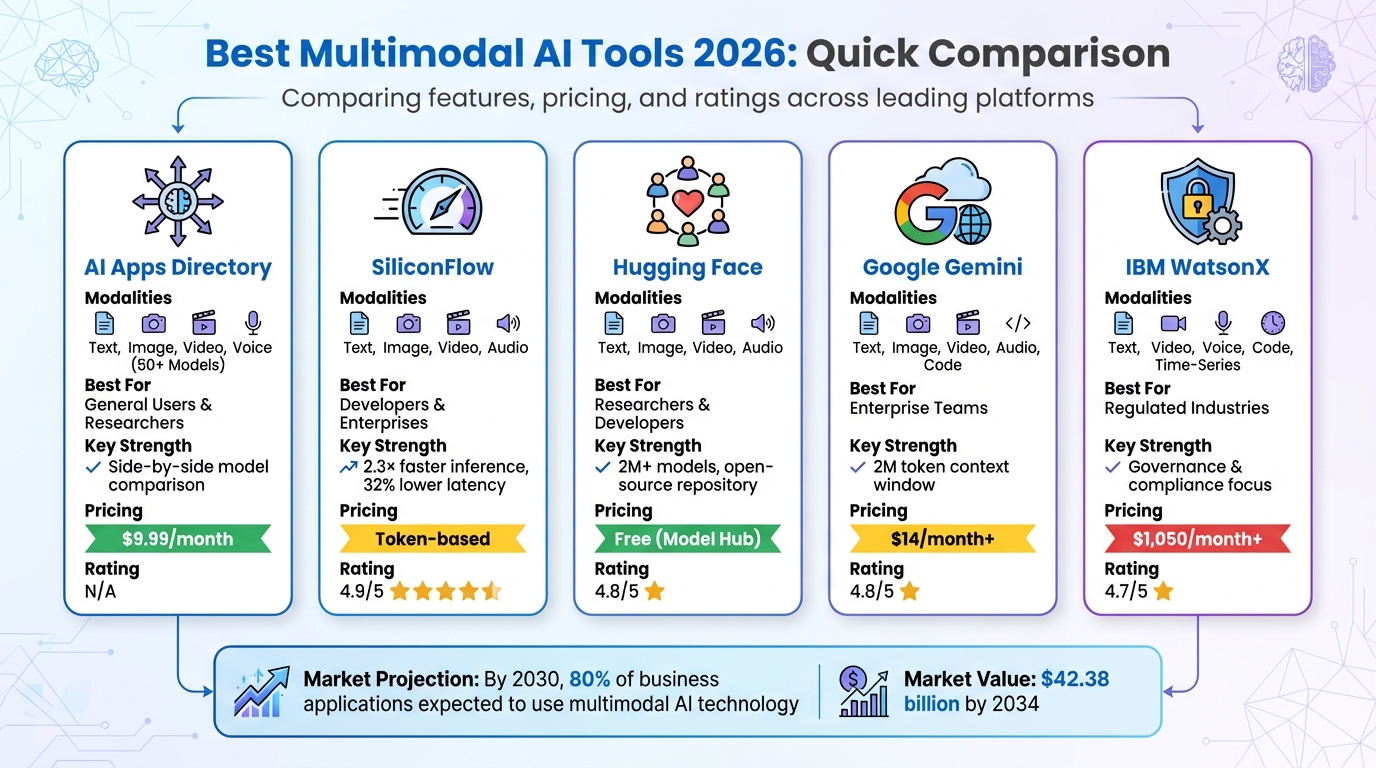
Multimodal AI Tools Comparison 2026: Features, Pricing and Ratings
Multimodal AI: LLMs that can see (and hear)
1. AI Apps Directory
The AI Apps Directory serves as a central hub for discovering multimodal AI tools. With over 1,000 applications spanning text, image, video, and voice, it provides a curated space where businesses and creators can find, compare, and choose the latest AI solutions. While not a tool itself, this directory simplifies the search for AI applications that combine multiple input and output formats. Here’s what makes it a go-to resource for multimodal AI solutions.
Modalities Supported
The directory organizes tools by their capabilities, including text-to-image generation, written content creation, voice command synthesis, and video analysis. With its user-friendly filtering system, you can refine searches to find tools tailored to specific needs - whether that’s converting speech to text, analyzing video content, or generating images from text prompts.
Target Use Cases
This platform is ideal for developers, marketers, and content creators who want to save time finding the right tools. Startups can explore options for building AI-powered products, while enterprise teams use it to discover solutions for tasks like automating customer service, producing content, or analyzing data. Each tool undergoes a rigorous verification process to ensure quality, providing users with reliable options in a constantly evolving AI market.
Strengths
The AI Apps Directory stands out by making it easier to navigate the crowded AI landscape. It showcases newly launched tools and features standout applications, giving users quick access to the latest innovations. Tools are grouped by functionality rather than technical jargon, making the platform approachable even for non-technical users. Developers can also submit their tools directly, ensuring the directory stays fresh and up to date.
Pricing
The directory operates on a freemium model. Basic listings are free and searchable across the platform, while paid featured listings offer premium placement on the homepage or top categories. This setup keeps the platform accessible to users while giving developers the option to promote their tools to a highly targeted audience actively seeking multimodal AI solutions.
2. SiliconFlow
SiliconFlow is an AI cloud platform built for developers and businesses seeking fast, scalable multimodal AI solutions without the hassle of managing complex infrastructure. With access to over 200 models via a single OpenAI-compatible API, it handles text, image, video, and voice processing. Its proprietary inference engine delivers impressive performance - 2.3× faster speeds and 32% lower latency compared to other top AI cloud platforms.
Modalities Supported
SiliconFlow covers all four major modalities: text, image, video, and audio. It also features omni-modal models like Qwen3-Omni, capable of processing multiple modalities - text, image, audio, and video - simultaneously. Real-time streaming latency is as low as 211 ms for audio-only tasks and 507 ms for combined audio and video tasks. The platform supports extended audio files (up to 30–40 minutes) and offers context windows ranging from 131,000 to 262,000 tokens, making it ideal for a variety of applications.
Target Use Cases
Thanks to its technical features, SiliconFlow shines in agentic workflows where AI systems need to perform multi-step reasoning and tool-based tasks. It’s particularly useful for automating enterprise document processing, navigating computer interfaces, and offering real-time code autocomplete with syntax-safe suggestions for developers. Creative teams can leverage its text-to-image and video generation tools for marketing content. Additionally, the platform's "Thinking Mode" in models like GLM-4.5V enables chain-of-thought reasoning, making it a valuable resource for complex analytical tasks in industries like finance and enterprise operations.
Strengths
One standout feature of SiliconFlow is its unified API, which allows developers to seamlessly switch between open-source and commercial models without rewriting code. The platform simplifies fine-tuning and customization through its three-step process: upload, configure, and deploy. Security is another major advantage, with a "no data stored" policy ensuring that proprietary models and training data remain protected. SiliconFlow also supports massive models like the Qwen3-VL series, which has up to 235 billion parameters, and it boasts a 4.9/5 rating for its blend of speed and accuracy.
Pricing
SiliconFlow uses a transparent, token-based pricing system. For example, DeepSeek-V3.2 costs $0.27 per million input tokens and $0.42 per million output tokens, while Qwen3-VL-32B-Instruct is priced at $0.20 per million input tokens and $0.60 per million output tokens. Image generation pricing starts at $0.005 per image for Z-Image-Turbo and goes up to $0.06 per image for FLUX.2. Video generation costs $0.29 per video. The platform offers flexible payment options, including serverless pay-per-use plans and reserved GPU plans for teams needing guaranteed capacity with NVIDIA H100, H200, or RTX 4090 hardware.
3. Hugging Face
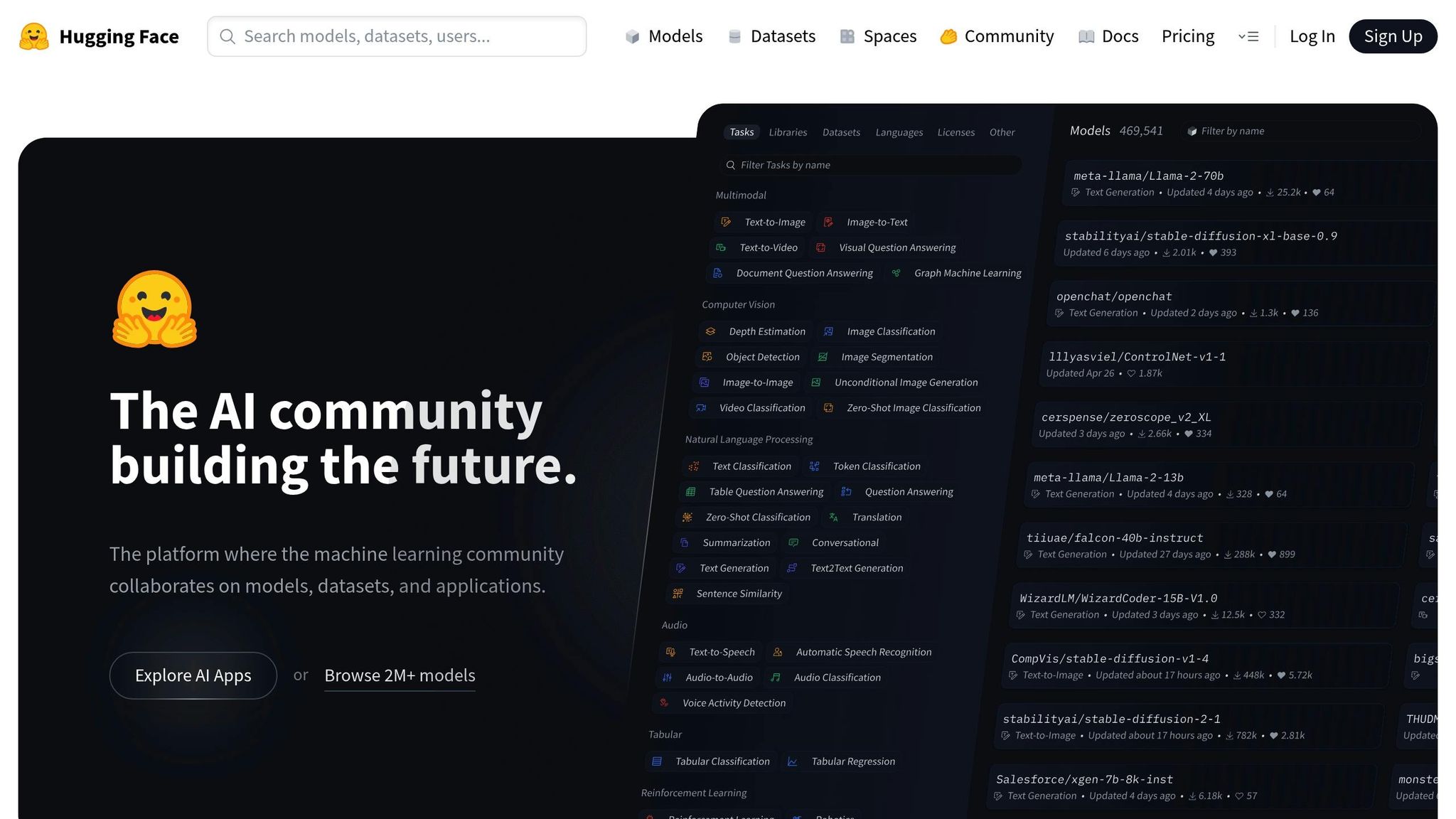
Hugging Face has become a go-to platform for machine learning, often referred to as the "GitHub for machine learning." By early 2026, it hosted over 2 million models, 1 million applications (Spaces), and 500,000 datasets. Major companies like Meta, Google, Amazon, and Microsoft are among the 50,000+ organizations leveraging its tools for multimodal AI projects. With a stellar 4.8/5 rating for its extensive model hub and strong community support, Hugging Face stands out as a key resource in the AI ecosystem.
Modalities Supported
The platform supports a wide range of modalities, including text, image, video, audio, and even 3D data. Hugging Face's core libraries - Transformers (boasting over 155,000 GitHub stars), Diffusers (for images, video, and audio), and Datasets - ensure smooth integration for developers. Its DiffusionPipeline provides a unified API, enabling users to create images, videos, and audio with just a few lines of code. Hugging Face also features advanced "Any-to-Any" models like Ming-Lite-Omni, launched in June 2025, which can handle text, images, audio, and video within a single framework powered by 2.8 billion parameters.
Target Use Cases
Hugging Face's multimodal capabilities open doors to a variety of applications. Developers rely on the platform for tasks like Visual QA, document processing, image-to-video generation, and visual document retrieval. It’s particularly effective in enterprise settings, offering tools like the PEFT library for fine-tuning models on private data and the smolagents library for building autonomous agents. Legal and administrative industries benefit from its document processing features, while research teams use its vast datasets for creating custom models.
Strengths
One of Hugging Face's biggest advantages is the ability to fully control and fine-tune models on your own infrastructure, all without per-token fees. Its standardized from_pretrained loading method and the Inference Providers feature - which grants access to over 45,000 models via a unified API - make integration straightforward and cost-effective. The Gradio tool is another highlight, allowing developers to quickly create multimodal web apps in Python, while the Optimum library provides hardware optimization for platforms like AWS Trainium and Google TPUs.
Pricing
Hugging Face offers free access to unlimited public models, datasets, and applications. For additional features like Single Sign-On (SSO), priority support, and private dataset viewers, Team and Enterprise plans start at $20 per user per month. GPU-backed Spaces and Inference Endpoints are available starting at $0.60 per hour. Plus, the Inference Providers feature lets users access over 45,000 models via a unified API without incurring extra fees beyond provider costs.
sbb-itb-212c9ea
4. Google Gemini
Google Gemini stands out as a cutting-edge multimodal AI platform, designed to handle a wide range of data types in a unified system. With its Gemini 3.0 iteration, it processes text, images, video, audio, code, and structured data seamlessly. By encoding all these modalities into a shared representation space, Gemini enables smooth cross-modal reasoning, making it a powerful tool for diverse applications.
Modalities Supported
Gemini 3.0 supports an impressive array of input types, including text, images, video, audio (spanning speech and sound patterns), code, and structured data. It processes video at speeds of up to 10 frames per second - 10 times faster than before - and can handle up to 1 million tokens in a single session. This means it can analyze entire books, thousands of lines of code, or even hour-long videos without missing a beat.
Target Use Cases
Gemini 3 Pro has already proven its value across industries:
- Software Development: GitHub integrated Gemini 3 Pro into Copilot for VS Code in January 2026, achieving a 35% boost in accuracy for software engineering tasks.
- Code Generation: JetBrains saw a 50% improvement in solving benchmark tasks, with the model generating thousands of lines of front-end code and even simulating operating-system interfaces from a single prompt.
- Operational Efficiency: Wayfair used Gemini 3 Pro to transform complex Standard Operating Procedures into clear, data-driven infographics for field associates.
- Transcription and Data Extraction: Rakuten Group Inc employed it to transcribe 3-hour multilingual meetings with enhanced speaker identification and to extract structured data from low-quality document images - outperforming baseline models by over 50%.
"In our early testing in VS Code, Gemini 3 Pro demonstrated 35% higher accuracy in resolving software engineering challenges than Gemini 2.5 Pro. That's the kind of potential that translates to developers solving real-world problems with more speed and effectiveness." - Joe Binder, VP of Product, GitHub
Strengths
Gemini 3 Pro shines in several areas:
- Complex Task Planning: It excels at planning multi-step sequences and executing them with precision, whether working on desktop or mobile environments.
- Benchmark Performance: The model scored 80.5% on the CharXiv Reasoning benchmark, surpassing human performance.
- Customizability: Developers can use the
media_resolutionparameter to adjust fidelity based on task requirements. For example, "High" works best for dense OCR or legal documents, while "Low" is suitable for general scene recognition. - Specialized Features: Gemini Live supports real-time brainstorming, while Deep Research enables detailed analysis of hundreds of sources simultaneously.
"Gemini 3 is a major leap forward for agentic AI. It follows complex instructions with minimal prompt tuning and reliably calls tools, which are critical capabilities to build truly helpful agents." - Mikhail Parakhin, CTO, Shopify
Pricing
Google offers a range of pricing plans to cater to different needs:
- Free Tier: $0/month, includes Gemini 3 Flash, limited access to 3 Pro, and image generation.
- Google AI Pro Plan: $19.99/month, providing higher access to Gemini 3 Pro, Deep Research, and video generation with Veo 3.
- Google AI Ultra Plan: $249.99/month, tailored for enterprise users, offering the highest limits, access to "Deep Think", and the Gemini Agent (available only in the US).
API pricing is tiered based on usage: $2.00 per 1 million input tokens (rising to $4.00 beyond 200,000 tokens) and $12.00 per 1 million output tokens (rising to $18.00 beyond 200,000 tokens).
5. IBM WatsonX
IBM WatsonX focuses on governance, compliance, and seamless technical integration for multimodal AI applications. Designed for industries with strict regulations - like healthcare, finance, and government - it brings together text, code, images, time-series data, and geospatial information into a single platform. The emphasis is on transparency and accountability, making it a trusted choice for mission-critical tasks. Let’s explore WatsonX’s supported modalities, practical applications, standout features, and pricing.
Modalities Supported
WatsonX supports a range of data types, including text, code, images, time-series data, and geospatial/satellite data, leveraging its Granite models. For image-to-text processing and visual reasoning, models like granite-vision-3-3-2b and third-party options such as llama-3-2-90b-vision-instruct are key players. Specialized models, such as the granite-timeseries-ttm-r2 for time-series analysis and geospatial models co-developed with NASA, extend its capabilities to areas like environmental monitoring. The platform also integrates voice and audio processing through watsonx Orchestrate, enabling conversational AI and voice-driven workflows.
Target Use Cases
WatsonX has demonstrated measurable benefits across various sectors. For instance:
- Vodafone: Achieved a 99% improvement in turnaround time for journey testing.
- NASA and IBM Collaboration: Developed foundation models to analyze satellite data, aiding Kenya in planting 15 billion trees and helping the UK monitor harmful algae blooms.
- Dun & Bradstreet: Enabled clients to cut over 10% of the time spent evaluating supplier risks.
- IBM: Reduced the time required to create Red Hat Ansible Playbooks by over 40% using watsonx Code Assistant.
- US Open: Processed 7 million data points to deliver real-time insights during the tournament.
"Watsonx.ai's governance-first design makes it ideal for mission-critical AI deployments where accountability is as important as accuracy." – ThirdEye Data Expert View
Strengths
WatsonX’s architecture prioritizes governance, automating risk management and ensuring compliance with regulatory standards - essential for industries with strict oversight [36,42]. The platform offers hybrid deployment options, allowing users to work with Granite models, open-source solutions, or custom models on any cloud environment. For AI-driven enterprises, the platform can save up to 90% of the time spent on tasks like code explanation. Its ecosystem, which includes watsonx.ai for development, watsonx.data for unified data management, and watsonx.governance for lifecycle management, provides a well-rounded solution for AI projects [36,39].
Pricing
IBM offers a free tier that includes 300,000 tokens per month and 20 Compute Usage Hours for machine learning tools. For more advanced needs:
- Essentials Plan: Free to start, with usage-based billing. For example:
granite-3-8b-instructmodel: $0.20 per 1 million tokens.llama-3-2-90b-vision-instructmodel: $2.00 per 1 million tokens.
- Standard Plan: Starts at $1,050 per month plus usage fees. It includes advanced features like LoRA fine-tuning and custom foundation model hosting.
- Additional costs include text extraction ($0.03 to $0.038 per page) and model hosting on NVIDIA A100 GPUs, which starts at $5.80 per hour.
Comparison: Pros and Cons
Deciding on the best multimodal AI tool boils down to what you need, how much you're willing to spend, and your technical expertise. Each tool comes with its own set of strengths and trade-offs, from supported modalities to pricing and target users. Here's a breakdown to help you weigh your options.
AI Apps Directory is a standout option if you're looking for a meta-platform that simplifies comparisons. It allows users to evaluate over 50 AI models side-by-side, eliminating the hassle of juggling multiple subscriptions. With a Pro plan starting at just $9.99 per month, it’s an affordable choice for those who value flexibility. As a discovery and comparison tool, it’s particularly helpful for researchers and general users exploring multimodal AI capabilities.
SiliconFlow shines when it comes to performance. It boasts 2.3× faster inference speeds and 32% lower latency, making it ideal for developers and enterprises. Its streamlined 3-step fine-tuning pipeline and token-based pricing add to its appeal, earning it a 4.9/5 rating for performance and adaptability. However, casual users might find it challenging due to its technical focus and steeper learning curve.
Hugging Face is a favorite among researchers and developers, offering thousands of pre-trained multimodal models for free. Its 4.8/5 rating reflects its value as a hub for the open-source community. That said, users often need robust local computational resources for fine-tuning, and the platform assumes a certain level of technical expertise for deploying models effectively.
Google Gemini is designed for handling large-scale tasks, with its impressive 2 million token context window capable of processing 2,000 pages of text or 2 hours of video simultaneously. Seamlessly integrated with Google Workspace, it’s a natural fit for enterprise teams already using tools like Gmail, Docs, and Drive. Pricing starts at $14 per month for Workspace users, with advanced AI Pro features available for $30 monthly. While its 4.8/5 rating highlights its strengths in ecosystem integration, those outside the Google environment may not find it as beneficial.
| Tool | Modalities | Target Use Case | Key Strengths | Pricing | Rating |
|---|---|---|---|---|---|
| AI Apps Directory | 50+ Models (Meta-platform) | General Users & Researchers | Side-by-side model comparison | $9.99/mo | N/A |
| SiliconFlow | Text, Image, Video, Audio | Developers & Enterprises | 2.3× faster inference; 3-step fine-tuning | Token-based | 4.9/5 |
| Hugging Face | Text, Image, Video, Audio | Researchers & Developers | Open-source repository; active community | Free (Model Hub) | 4.8/5 |
| Google Gemini | Text, Image, Video, Audio, Code | Enterprise Teams | 2M token context; integrated video processing | $14/mo+ | 4.8/5 |
| IBM WatsonX | Text, Video, Voice, Code, Time-Series | Regulated Industries | Explainable AI; high security and compliance | $1,050/mo+ | 4.7/5 |
The pricing differences reflect variations in features like context caching and reasoning capabilities. For those managing high-volume tasks, a cost-effective strategy could involve using basic "mini" or "flash" tiers for standard operations while reserving premium models for more complex workloads.
Conclusion
Choosing the right multimodal AI platform comes down to your specific needs, budget, and technical priorities. Each of the five platforms reviewed brings distinct strengths to the table, catering to a variety of users and organizational setups.
AI Apps Directory is a great first step for teams exploring multimodal AI. It offers side-by-side comparisons of over 50 models for just $9.99 per month, making it an affordable resource for navigating options. SiliconFlow stands out with its high-speed performance - 2.3× faster inference and 32% lower latency. Its 3-step fine-tuning process and token-based pricing make it a favorite among developers and enterprises looking for scalable, fast solutions, earning it a 4.9/5 user rating.
For those prioritizing open-source flexibility, Hugging Face remains a top choice. It provides free access to thousands of pre-trained models and a vibrant community of contributors. Meanwhile, Google Gemini shines in large-scale document and video analysis. With its 2-million token context window, it can process massive inputs like 2,000 pages of text or 2 hours of video, making it a strong fit for enterprise teams already integrated into Google Workspace. IBM WatsonX is the platform to consider for industries like finance and healthcare, where compliance is crucial. Its focus on audit trails, explainable AI, and governance ensures it meets strict regulatory needs.
Pricing options are flexible, ranging from freemium plans to enterprise packages starting at $1,050 per month, making these tools accessible to businesses of all sizes. With the multimodal AI market expected to hit $42.38 billion by 2034, selecting the right platform now can give your organization a competitive edge. Align your choice with your operational goals and budget to unlock the full potential of multimodal AI across text, image, video, and voice applications.
FAQs
What are the key advantages of adopting multimodal AI tools early?
Getting a head start with multimodal AI tools can offer some serious perks. These tools bring together text, image, video, and voice processing, making it easier for businesses to streamline operations, boost productivity, and deliver results that are not only accurate but also context-aware. This can make a big difference in areas like customer service, content creation, and automation.
Adopting these tools early also means gaining a competitive edge. By embracing cutting-edge technology, businesses can drive innovation and make smarter decisions. With the multimodal AI market expected to grow rapidly in the coming years, early adopters are in a prime position to ride the wave of new trends, cut down on future integration costs, and stay ahead of the curve as technology continues to evolve.
How does SiliconFlow's pricing work compared to other platforms?
SiliconFlow provides a pay-as-you-go pricing model that adapts to the needs of businesses, whether small startups or large enterprises. Unlike fixed-cost plans, this setup lets companies pay solely for the resources they actually use. This approach helps manage expenses while allowing businesses to scale up or down based on project requirements.
With an emphasis on clear and predictable pricing, SiliconFlow makes it easier for businesses to budget for multimodal AI projects. This way, companies can tap into advanced AI tools without worrying about overspending or surprise costs. It's all about balancing cost control with scalability.
What is the best multimodal AI platform for industries like healthcare and finance that require strict accuracy and compliance?
For industries such as healthcare and finance, where precision and strict compliance are non-negotiable, MIRA emerges as a standout option. Built for high-stakes environments, it combines multimodal reasoning with external knowledge bases to deliver outputs that are both accurate and consistent. Its emphasis on factual correctness and risk management makes it a natural fit for regulated sectors.
Another excellent contender is Nova 2 Omni, which integrates text, image, video, and audio processing into a single framework. This unified design streamlines data analysis while meeting the demanding requirements of industries like healthcare and finance. Meanwhile, Gemini 2.5 showcases advanced capabilities in managing complex multimodal data and extended context, making it a reliable tool for decision-making in sensitive and detail-oriented fields.
While all three platforms bring distinct advantages, MIRA is particularly well-suited for medical applications. On the other hand, Nova 2 Omni and Gemini 2.5 shine in broader multimodal scenarios that require a high level of accuracy and dependable performance.