AI Ethics And Governance
OpenAI Frontier vs. Google AI Agents: Which One Runs Your Business Better?”
Compare Frontier’s multi-vendor flexibility with Google AI Agents’ cloud-native, cost-effective integration to choose the best enterprise AI approach.

OpenAI Frontier vs. Google AI Agents: Which One Runs Your Business Better?”
Choosing between OpenAI Frontier and Google AI Agents depends on your business needs. Here’s the key difference: OpenAI Frontier is a flexible platform that supports multiple AI providers, making it suitable for businesses with diverse systems. Google AI Agents, on the other hand, is deeply integrated with Google Cloud and Workspace, offering a streamlined solution for businesses already in the Google ecosystem.
Key differences:
- OpenAI Frontier: Multi-vendor support, tailored workflows, and on-site engineers for custom integration. Ideal for businesses with legacy systems or those needing cross-platform AI management.
- Google AI Agents: Optimized for Google’s ecosystem, faster for structured tasks, and more affordable with transparent pricing. Best for businesses already using Google Cloud.
Quick Overview:
- OpenAI Frontier offers custom pricing, requires technical expertise, and focuses on flexibility across vendors.
- Google AI Agents have a simpler setup, lower costs, and strong integration with Google tools.
Quick Comparison
| Feature | OpenAI Frontier | Google AI Agents |
|---|---|---|
| Core Philosophy | Multi-vendor AI management | Google ecosystem integration |
| Integration | Works with various providers | Best with Google Cloud and Workspace |
| Setup | Complex, requires technical expertise | Simple, self-serve for Google users |
| Pricing | Custom enterprise pricing | Transparent, pay-as-you-go |
| Best For | Businesses with diverse systems | Companies already in Google’s ecosystem |
Ultimately, your choice should align with your current infrastructure and long-term AI strategy. OpenAI Frontier is better for flexibility, while Google AI Agents excel in simplicity and speed within a Google-centric setup.
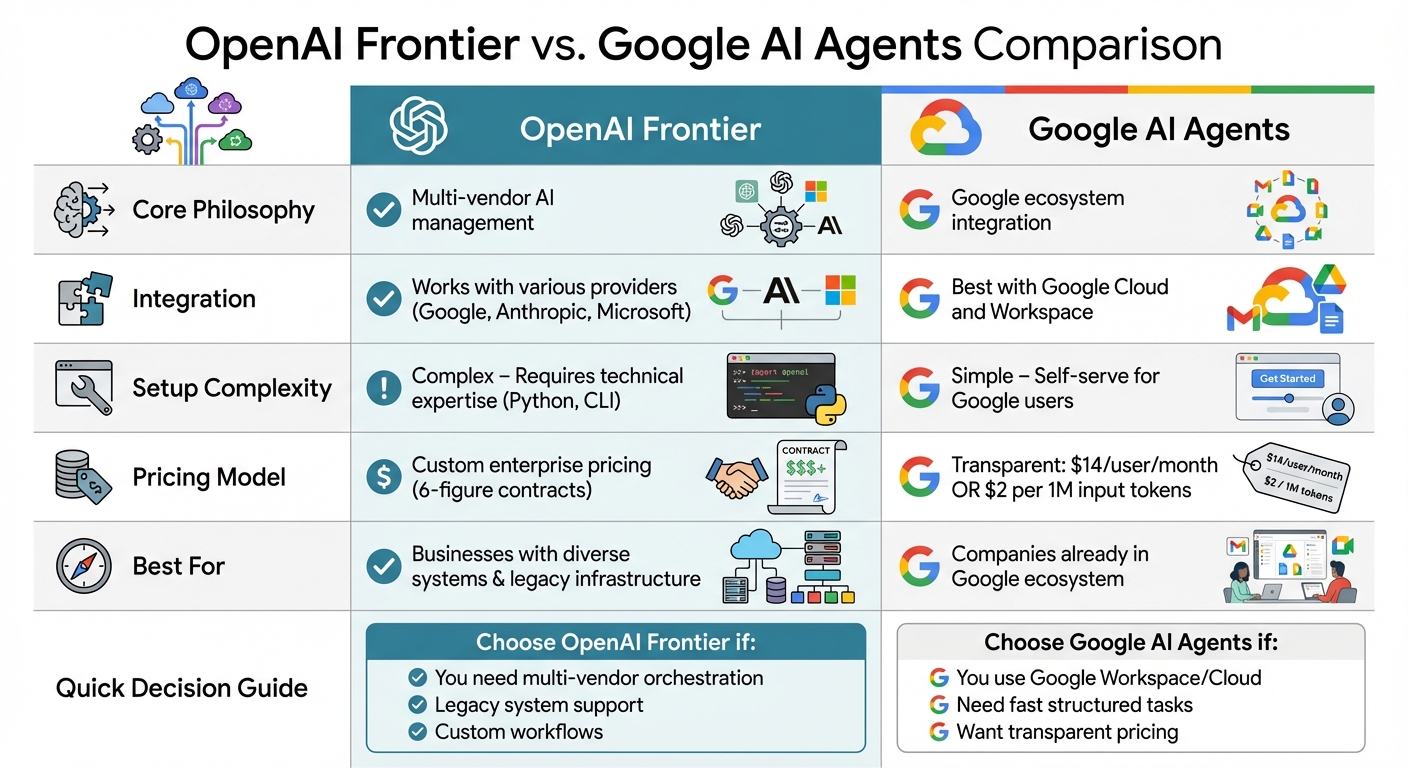
OpenAI Frontier vs Google AI Agents: Feature Comparison Chart
Core Features: OpenAI Frontier vs. Google AI Agents
OpenAI Frontier: Main Features and Benefits
OpenAI Frontier serves as a multi-vendor operating system tailored for enterprise AI, designed to coordinate AI automation tools from various providers. Its Shared Business Context acts as a semantic layer, seamlessly connecting tools like data warehouses, CRM systems, and internal applications - without requiring companies to overhaul their existing setups.
The Agent Execution Engine handles complex, multi-step workflows, such as running code, processing files, and updating systems in one streamlined process. A notable example occurred in February 2026 when HP implemented IT support agents that accessed internal databases to resolve issues, significantly reducing the need for manual intervention.
What makes Frontier stand out is its open, model-agnostic framework. Unlike systems tied to a single AI provider, Frontier supports agents built on models from multiple vendors, all managed through a unified control layer. It even mirrors human workplace practices by assigning granular permission profiles to agents, ensuring they access only the data relevant to their specific tasks. Additionally, Forward Deployed Engineers work on-site to create custom integrations, enabling direct feedback loops with OpenAI's research team.
For example, State Farm collaborated with OpenAI in February 2026 to roll out Frontier to thousands of employees and agents. This deployment enhanced AI-driven capabilities in areas like claims processing and customer service. In another case, a leading hardware manufacturer used Frontier to reduce the time needed to identify the root cause of hardware test failures from roughly 4 hours to just a few minutes, saving thousands of engineering hours annually.
Now, let’s explore the strengths of Google AI Agents.
Google AI Agents: Main Features and Strengths
Google AI Agents build on the multi-vendor flexibility seen in Frontier but lean heavily into deep cloud integration to simplify enterprise operations. Powered by Gemini 3.1 Pro and built on Vertex AI, these agents adopt a code-first, cloud-native design, seamlessly integrating with Google Cloud's ecosystem. With a 1 million token context window, they can process entire codebases or large datasets in a single prompt.
The platform’s API-first workflow execution makes it particularly effective for structured, deterministic processes where consistent and reliable outcomes are critical. Moreover, its real-time data processing capabilities are enhanced by native integrations with Google Cloud and Workspace tools like Gmail, Drive, and Calendar. Gemini 3.1 Pro has also demonstrated its capabilities by achieving a 94.3% score on the GPQA Diamond benchmark for expert-level scientific knowledge.
Pricing for Google AI Agents is based on usage, costing $2.00 per 1 million input tokens and $12.00 per 1 million output tokens. Unlike Frontier, which is still in limited preview, Google AI Agents are widely available to businesses ranging from individual developers to large enterprises. However, this accessibility comes with a tradeoff: organizations that adopt Google AI Agents often experience higher ecosystem lock-in, as the platform performs best when paired with Google Cloud and Vertex AI infrastructure.
The contrast between Frontier's vendor flexibility and Google's deep ecosystem integration highlights the key considerations for choosing the right platform for your business.
sbb-itb-212c9ea
Feature Comparison: Strengths and Weaknesses
Comparison Table: Features and Performance
OpenAI Frontier and Google AI Agents approach enterprise AI from very different angles. OpenAI Frontier acts as an "operating system" for multi-vendor agents, while Google AI Agents is more about an ecosystem-locked hyperscaler integration. This fundamental difference influences how these platforms are implemented and the level of control users retain over their AI systems.
| Feature | OpenAI Frontier | Google AI Agents |
|---|---|---|
| Core Philosophy | Operating system for multi-vendor agents | Ecosystem-locked hyperscaler integration |
| Orchestration | Handoff only (no delegation) | Handoff + Delegation |
| Data Context | Centralized semantic layer across all tools | Integrated with Google Cloud/BigQuery |
| Support Model | Embedded Forward Deployed Engineers | Standard Cloud Support/Account Management |
| Vendor Lock-in | Low (supports third-party models) | High (optimized for Google ecosystem) |
| RAG Control | Managed and opaque | Fully configurable |
| Source Attribution | Unstructured anchoring | Structured inline citations |
One of the key differences lies in orchestration. OpenAI Frontier supports only "handoff" patterns, where control is permanently transferred from one agent to another. In contrast, Google AI Agents supports both handoff and "delegation", where a supervisor agent assigns tasks and maintains oversight.
Another major distinction is in RAG (retrieval-augmented generation) transparency. Google AI Agents allows users to fine-tune chunking strategies and embedding models, offering a high degree of customization. On the other hand, Frontier's knowledge retrieval process is more opaque, making it harder for compliance teams to trace how specific information was retrieved. Google's structured inline citations provide clear audit trails, which Frontier's unstructured anchoring cannot match.
Where Each Platform Performs Best
Building on the comparison above, here’s a closer look at where each platform shines.
OpenAI Frontier is ideal for businesses working with legacy systems that lack modern APIs. Its visual navigation capabilities allow agents to interpret rendered page layouts and DOM structures. This makes it a strong choice for organizations using older software that doesn’t easily integrate with modern tools. Additionally, OpenAI provides Forward Deployed Engineers who work closely with your team to create custom workflows and ensure seamless implementation. This hands-on approach is especially helpful for businesses needing to integrate legacy systems. These engineers also relay insights back to OpenAI’s research team, which can speed up deployment but may require a deeper organizational commitment.
"For structured API tasks, Vertex is faster. For open web navigation, Operator is more flexible." - Power Digital Media
Google AI Agents, on the other hand, excels in high-volume, structured workflows where speed and precision are critical. Its API-first design and strong integration with Google Cloud make it the go-to choice for companies already invested in the Google ecosystem.
OpenAI Frontier’s semantic layer offers what can be described as a "durable institutional memory", allowing agents to track customer service tickets across departments or monitor changes in a sales pipeline over time. This capability is particularly useful when long-term context is essential.
For businesses that prioritize centralized governance, Google's fleet-level visibility and policy controls provide a clear advantage over Frontier’s per-agent identity management system.
Implementation and Cost Considerations
Pricing Models: Outcome-Based vs. Standard Pricing
OpenAI Frontier follows a custom enterprise pricing model, requiring businesses to contact sales for a tailored quote. The cost depends on several factors: the number of active agents deployed, the volume of data connected to the Business Context layer, API usage, and - most notably - the level of Forward Deployed Engineer (FDE) support needed. These FDEs, who work directly with organizations to deploy agents, often come with six-figure annual contracts.
On the other hand, Google AI Agents offers a more straightforward pricing structure. It costs $14 per user per month, bundled with Google Workspace, which is a drop from its original price of $32 per user per month. Companies already using Google Cloud can also access AI Agents through pay-as-you-go API tiers or their existing cloud commitments. For example, Google's Gemini 3.0 Pro charges $2.00 per million input tokens and $12.00 per million output tokens, supporting a 2-million-token context window.
When it comes to compute costs, Google has a clear edge. By designing its own Tensor Processing Units (TPUs), Google achieves AI computing costs at approximately 20% of what high-end Nvidia GPUs would require. Comparatively, OpenAI's o3 model is about eight times more expensive for input tokens and four times more expensive for output tokens when compared to Google's Gemini 2.5 Pro.
Cost-saving strategies like context caching can significantly reduce expenses. For instance, context caching for repeated queries can lower input costs by 50–90%. A customer support bot processing 5,000 tokens daily could see costs drop from $250 to just $25. Additionally, routing most queries - 70% or more - to budget-friendly models like GPT-5-mini (at $0.30 per million input tokens) or Gemini 3.0 Flash (at $0.50 per million input tokens) can cut expenses by up to 85% while still maintaining 95% quality.
With these pricing structures in mind, the next step is to consider the technical setup and integration requirements, which vary significantly between the two platforms.
Technical Requirements and Setup Complexity
The technical setup for these platforms highlights their differences. OpenAI Frontier requires a more involved process. Businesses need to handle a CLI-based setup (using commands like "pip install openai-frontier") and a Python SDK to initialize workspaces and define agents. Teams must have expertise in Python and CLI to integrate the Business Context layer with systems like Snowflake, BigQuery, and Salesforce. Since it is not a low-code or no-code solution, OpenAI Frontier isn’t available for self-serve signup. Implementation often takes several months, largely due to the involvement of Forward Deployed Engineers, who bring deep expertise to bridge research and production needs.
In contrast, Google AI Agents offers a more accessible, self-serve setup through tools like Vertex AI and AI Studio. For enterprises already using Google Cloud, integration is relatively seamless, as the agents fit naturally into existing Google infrastructure. This ease of use makes it an attractive option for many companies.
Both platforms, however, require careful attention to data governance before deployment. For example, Frontier’s semantic layer can amplify any inconsistencies in the data, making clear data definitions and ownership crucial. For sensitive actions such as financial transactions, adding approval gates within the agent's permission profile is a necessary precaution.
These technical and pricing distinctions play a critical role in helping businesses determine which platform aligns best with their operational needs and strategic goals.
Conclusion: Which Platform Fits Your Business?
After diving into the comparisons, it’s clear that the right platform depends on your business’s specific needs and priorities.
Key Takeaways
OpenAI Frontier and Google AI Agents represent two very different approaches to enterprise AI. Google leans into its existing cloud and Workspace ecosystems, embedding AI to refine and optimize current workflows. OpenAI, however, takes a consumer-first perspective, positioning ChatGPT as a potential replacement for traditional SaaS models.
Google AI Agents shine when it comes to high-speed, API-driven execution, making them a go-to choice for structured, high-volume tasks within the Google environment. Meanwhile, OpenAI Frontier offers a multi-vendor control plane, enabling businesses to manage agents from Google, Anthropic, and Microsoft under a unified framework. This flexibility comes with a significant investment, often requiring custom contracts and Forward Deployed Engineer support, with annual costs in the six-figure range.
Google’s focus is on structured endpoints and centralized governance, while OpenAI emphasizes visual autonomy, which is especially useful for legacy systems without APIs. These contrasting strategies illustrate two different visions for integrating AI into enterprise workflows.
How to Choose the Right Platform
Here’s a simple guide to help you decide which platform aligns with your organization’s goals:
- Choose Google AI Agents if your business already relies heavily on Google Workspace and Cloud, values centralized IT governance, and needs fast, structured workflow execution. For companies embedded in Google’s ecosystem, the integration is straightforward, and its transparent pricing simplifies financial planning.
- Choose OpenAI Frontier if you require a platform to orchestrate agents from multiple vendors, need automation for systems without APIs, or want a programmable framework for custom, developer-driven solutions. Organizations like Uber, State Farm, and Intuit have turned to Frontier for its ability to manage diverse agent networks and connect siloed data sources. To get started, focus on narrow, well-defined use cases - like internal support or document processing - and implement human oversight for high-risk tasks before scaling further. It’s worth noting that most generative AI pilots face hurdles in reaching production, so thorough planning and robust data governance are critical.
FAQs
How do I know which platform fits my current tech stack?
To find the right solution, evaluate how well it aligns with your systems, security requirements, and specific use cases. OpenAI Frontier stands out with its open architecture, strong security features, and ability to integrate with third-party tools, making it a great option for flexible and scalable setups. If your technology stack involves multiple internal tools and demands enterprise-level security, Frontier could be an excellent choice. For more tailored requirements, a deeper analysis may be necessary.
What does “vendor lock-in” mean for my long-term AI strategy?
"Vendor lock-in" happens when a company becomes too dependent on one AI provider, making it both challenging and expensive to transition to a different platform. This reliance can hinder flexibility, stifle progress, and elevate risks in the long run. To steer clear of this issue, it's wise to use open standards and build a flexible infrastructure. This approach helps ensure you retain control and can adjust your AI strategy as needed.
What data and governance work should I do before deploying agents?
Before rolling out AI agents, it's crucial to have data and governance frameworks firmly in place to ensure safety, compliance, and smooth operations. Start by implementing permissions, access controls, and systems for tracking agent activities. Define shared business contexts, create clear onboarding protocols, and establish robust security measures to oversee how agents interact with internal systems and handle data. These steps are essential for reducing risks and enabling the secure growth of AI agents in enterprise settings.