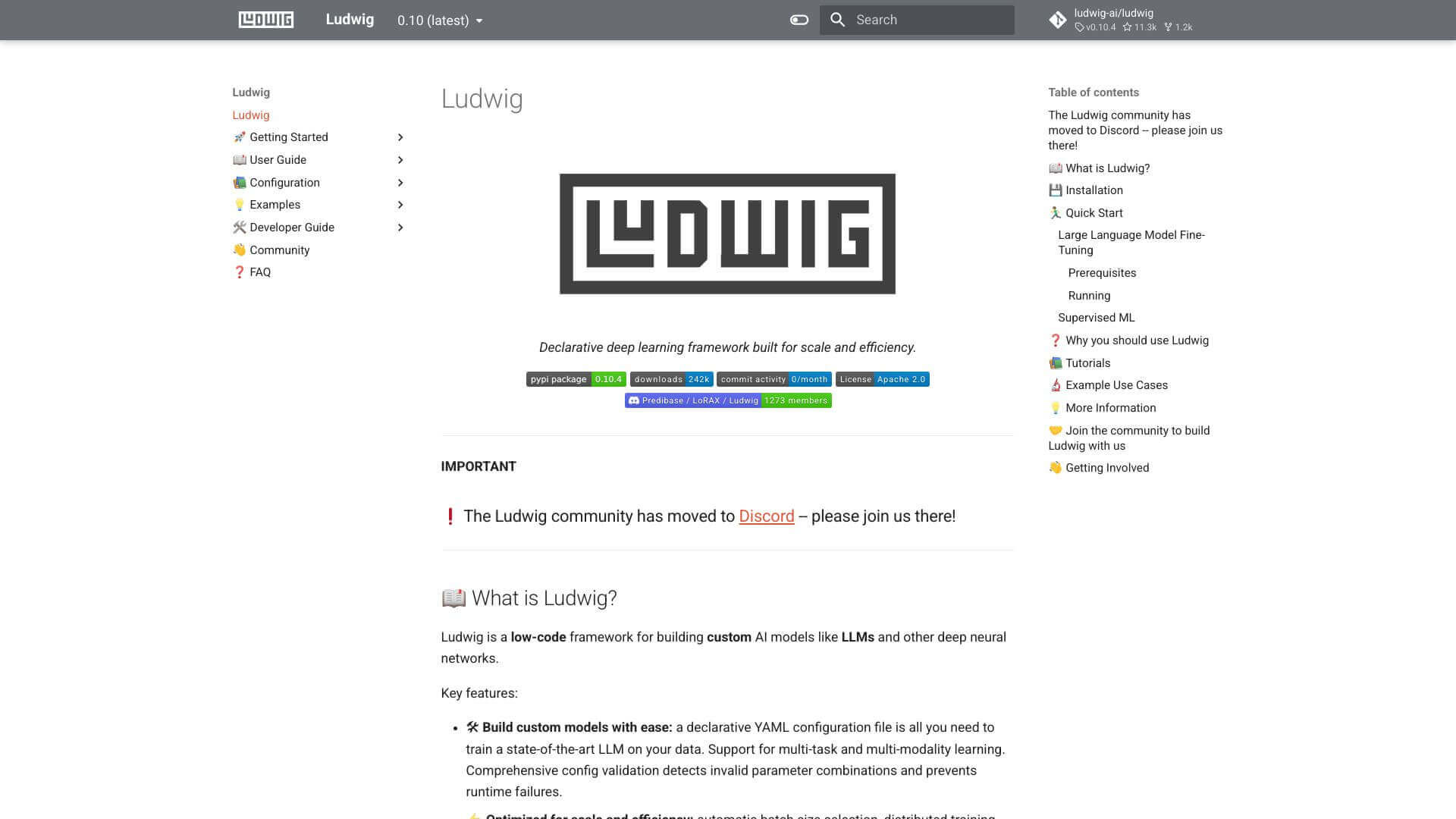
Ludwig is a Misc AI tool. Lets you train machine learning models super easily, even without coding. Perfect for trying out AI! Key features include No-Coding Required, Flexible Architecture, and Data Type Abstractions. Best for data scientists and analysts, software developers and engineers and scientists and researchers.
About Ludwig
Ludwig is an open-source machine learning framework that lets users train AI models through configuration files rather than code. The platform handles text, images, categorical data, and other types through a modular architecture, targeting both developers experimenting with ML and researchers who want flexibility without writing custom model code for each project.
The core features that matter
- No-coding required for training models, using dataset and configuration files instead of Python code for typical ML workflows
- Flexible architecture with modular encoders, decoders, and other components that can be swapped or extended for different model designs
- Data type abstractions handling text, images, categorical data, and other types with appropriate processing for each
- ECD architecture (Encoder-Combiner-Decoder) supporting mix-and-match of different inputs and outputs for diverse model designs
- Distributed training through Ray integration for splitting work across multiple machines, including fine-tuning and generative AI applications
- Custom LLM support for building and tuning your own large language models alongside other model types
How it stands out
The ML framework space has dominant tools including TensorFlow, PyTorch, and JAX for general ML development, plus higher-level frameworks like Keras and fastai. Ludwig's specific position is the declarative configuration approach — describing what you want rather than coding how to train it. For non-expert users or rapid prototyping, that configuration approach is meaningfully more accessible than writing PyTorch from scratch.
The honest qualifier: declarative ML frameworks work well for standard problems and produce less optimal results for novel research that requires precise control over model architecture and training behavior. Ludwig handles common cases efficiently but power users typically graduate to direct framework use when they need flexibility Ludwig doesn't support. For researchers and developers exploring ML capabilities without deep framework expertise, Ludwig provides genuine accessibility. For production ML systems where every percentage point of accuracy matters or unusual architectures are required, direct PyTorch or similar still produces better results.
Key Features
No-Coding Required.
Flexible Architecture.
Data Type Abstractions.
ECD Architecture.
Distributed Training.
Support for Custom LLMs.
Frequently Asked Questions
Ludwig works with text, images, categories, sequences, sets, bags, and time series data.
Yes, Ludwig lets you extend its features with custom components.
No, you can start by just giving it data and setting up your models using YAML files.
Yes, it works with tools like Deepspeed and Ray for training really big models across multiple machines.