Digital Transformation
Top AI News for March 2026: Breakthroughs, Launches & Trends You Can’t Miss
March 2026 AI roundup: major partnerships, breakthrough hardware, falling costs, and growth in edge, multimodal, and agentic AI.

Top AI News for March 2026: Breakthroughs, Launches & Trends You Can’t Miss
This month, AI saw major advancements across industries, with new partnerships, hardware launches, and cost reductions making advanced tools more accessible. Here’s a quick roundup of the biggest developments:
- Apple & Google Partnership: Siri now integrates Google’s Gemini AI, enabling smarter, privacy-focused interactions.
- NVIDIA’s Vera Rubin Platform: New hardware reduces AI training costs by 10× and boosts efficiency for trillion-parameter models.
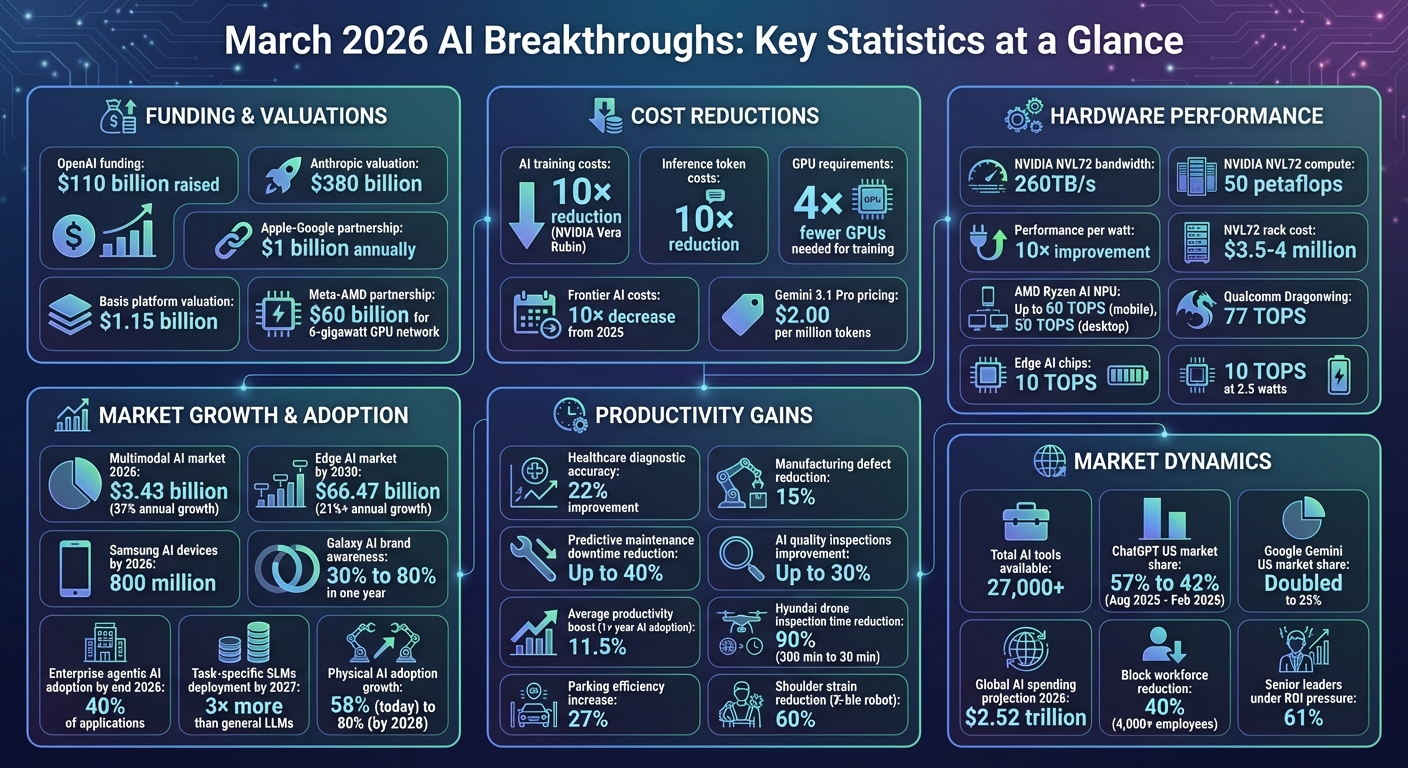
- OpenAI & Anthropic Funding: OpenAI raised $110 billion, while Anthropic hit a $380 billion valuation, driving AI innovation.
- Falling AI Costs: Frontier AI costs are down 10× from 2025, with tools like Gemini 3.1 Pro priced at $2.00 per million tokens.
- Edge AI Growth: Real-time, on-device AI expands with hardware like Qualcomm’s Dragonwing processor, enabling faster, local processing.
- Samsung’s AI Push: Plans to integrate AI into 800M devices by year-end, from smartphones to home appliances.
These shifts are transforming AI into a mainstream tool for businesses and consumers alike, offering faster, cheaper, and more efficient solutions.
March 2026 AI Industry Key Statistics and Market Trends
Major AI Developments in March 2026
Apple's AI-Powered Siri Overhaul
Apple has taken a bold step by teaming up with Google in a high-profile partnership worth about $1 billion annually. This collaboration integrates Google's Gemini models into Siri, marking a shift from Apple's traditionally closed ecosystem. The updated Siri now boasts on-screen awareness, allowing it to interact with content in real time. For instance, it can retrieve flight details from emails and coordinate plans across apps - all with a single command.
Siri’s capabilities have expanded to include contextual understanding, such as recalling names from old texts or emails. Despite leveraging Google’s technology, Apple ensures user privacy through its Private Cloud Compute standards, processing data either on-device or on Apple-controlled servers. However, early tests revealed some hiccups, including delays and inaccuracies, prompting a gradual rollout.
"After careful evaluation, Apple determined that Google's AI technology provides the most capable foundation for Apple Foundation Models and is excited about the innovative new experiences it will unlock for Apple users." – Joint Statement from Apple and Google
While Siri gets smarter, the infrastructure behind AI is also evolving at a rapid pace.
NVIDIA Vera Rubin AI Platform Debut
NVIDIA has unveiled the Vera Rubin platform, a game-changer for data center computing. This platform features a six-chip co-design tailored for trillion-parameter models. At its core are the Vera CPU, Rubin GPU, and NVLink 6 Switch, enabling a 10× reduction in inference token costs and requiring 4× fewer GPUs for training massive Mixture-of-Experts models.
With 50 petaflops of NVFP4 compute power, the NVL72 rack delivers a staggering 260TB/s of bandwidth - surpassing the total bandwidth of the entire internet. Fully liquid-cooled, it offers 10× better performance per watt compared to its predecessor. Microsoft plans to integrate these NVL72 rack-scale systems into its Fairwater AI superfactories, scaling them to hundreds of thousands of Superchips. Analysts estimate the cost of each NVL72 rack-scale system to be between $3.5 million and $4 million.
AMD Ryzen AI 400 Series Processors
On the consumer side, AMD has introduced the Ryzen AI 400 Series, the first desktop processors designed specifically for Microsoft Copilot+ experiences. These processors feature a triple-engine architecture combining Zen 5 CPU cores, RDNA 3.5 graphics, and the XDNA 2 NPU, optimizing AI workloads. Mobile variants deliver up to 60 NPU TOPS, while desktop models offer up to 50 NPU TOPS.
The Ryzen AI PRO 400 Series mobile processors outperform Intel’s Core Ultra X7 358 by up to 30% in multithreaded tasks. AMD also launched the Ryzen AI Halo developer platform, supporting up to 128GB of unified memory and enabling local processing of models with up to 200 billion parameters. This on-device capability enhances privacy and reduces latency for sensitive tasks. AM5 desktop systems from brands like HP and Lenovo are expected to hit the market in Q2 2026.
"The desktop PC is evolving from a tool you use to an intelligent assistant that works alongside you." – Jack Huynh, Senior Vice President and General Manager, Computing and Graphics Group, AMD
sbb-itb-212c9ea
AI Trends and Industry Changes in March 2026
Multimodal AI and Agentic Workflow Advances
AI systems today are breaking barriers by processing multiple types of data - text, images, audio, and even sensor inputs - all at the same time. This unified approach eliminates the need for separate models, making AI more cohesive and efficient. The global market for multimodal AI is expected to hit $3.43 billion by the end of 2026, with an annual growth rate of 37%.
Another major development is the rise of agentic workflows, which are transforming how AI operates. With advanced models like Gemini 3 and Claude 4.6, these agents can dynamically select the best course of action. They come equipped with features like persistent memory - remembering user preferences across sessions - and the ability to pause and seek clarification when faced with uncertainty. Experts estimate that by the end of 2026, 40% of enterprise applications will incorporate task-specific agentic AI.
"Multimodal intelligence 2026 is not about being advanced. It's about being operationally coherent." – Anand Padia, Associate Vice President, Trigent Software
The real-world applications of these technologies are impressive. In healthcare, multimodal systems combining radiology images, patient histories, and speech data are delivering diagnostic confidence scores that are 22% more accurate than single-data-type models. Similarly, manufacturing has seen a 15% drop in post-assembly defects thanks to systems that integrate visual and acoustic AI. Microsoft's Magma foundation model is another standout, bridging digital and physical tasks. It enables robots to navigate user interfaces and perform real-world actions using innovative techniques like Set-of-Mark and Trace-of-Mark.
For businesses aiming to adopt agentic AI, a good starting point is automating repetitive, rule-heavy tasks such as invoice processing or claims handling. Initially, design agents to manage around 60–70% of cases before expanding their capabilities. To make the most of multimodal AI, ensure your data infrastructure can store and cross-reference diverse data types with compatible metadata. When choosing platforms, prioritize those with persistent memory that supports data retention compliance and multi-user isolation.
While multimodal and agentic AI are reshaping how systems reason, Edge AI is taking data processing to a whole new level.
Edge AI and Open-Source Efficiency
Edge AI is revolutionizing data processing by analyzing information directly at the source, enabling real-time decisions with minimal latency - something cloud systems can't match. This market is projected to grow to $66.47 billion by 2030, with an annual growth rate exceeding 21%.
Key to this shift are hardware breakthroughs. Neural Processing Units (NPUs) and specialized AI chips now deliver up to 10 trillion operations per second (TOPS) at just 2.5 watts, making them six times more efficient than traditional CPUs for neural tasks. For instance, Qualcomm's Dragonwing Q-8750 processor, launched in early 2026, achieves 77 TOPS and supports on-device Large Language Models with up to 11 billion parameters, eliminating the need for cloud computing in critical navigation scenarios. Meanwhile, Nordic Semiconductor's nRF54L Series introduces an Axon NPU that uses "Neuton" edge AI models under 5 KB in size - 10 times smaller and faster than CPU-based models.
On the software side, open-source AI is empowering businesses to deploy efficient, task-specific solutions. Small Language Models (SLMs) are gaining traction as companies move away from general-purpose LLMs, opting for models that require less computing power but still deliver 80–90% of the performance. By 2027, task-specific SLMs are expected to be deployed three times more often than general-purpose LLMs. Edge-based systems are already proving their worth, with predictive maintenance reducing unplanned downtime in manufacturing by up to 40%, and AI-driven quality inspections improving production quality by up to 30%.
"Edge AI isn't just an improvement; it's a capability shift that legacy architectures can't match." – Valentyn Kropov, Chief Technology Officer, N-iX
Open-source models are accelerating this trend, offering a cost-effective alternative to proprietary systems. These models not only reduce licensing costs but also allow full customization. For businesses, the next step is identifying workloads that demand instant responses or high privacy standards. Deploying SLMs for offline troubleshooting or voice interfaces can be particularly valuable in remote areas with limited connectivity.
New AI Product Launches and Platform Expansions
Samsung's Gemini AI Expansion
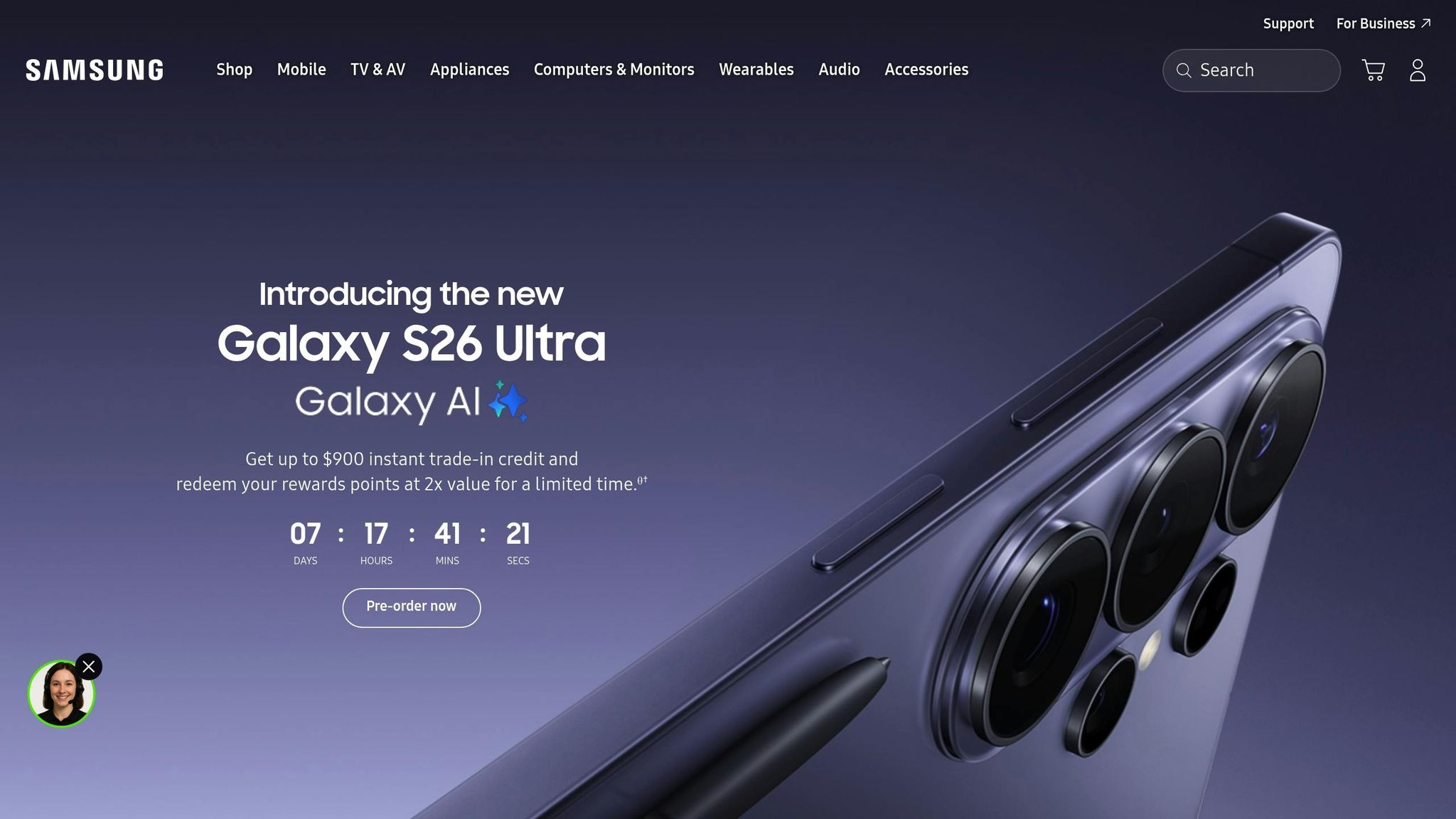
Samsung plans to integrate Gemini AI into 800 million devices by 2026. This integration goes beyond flagship smartphones, extending to products like smart refrigerators and home appliances. In 2025 alone, Samsung reached 400 million AI-enabled devices, with consumer awareness of the Galaxy AI brand skyrocketing from 30% to 80% in just a year.
This shift introduces "Agentic AI", where devices handle complex, multi-step tasks independently - things like coordinating dinner orders, building grocery lists, and managing logistics across apps. The Personal Data Engine customizes preferences locally, while Scam Detection uses on-device Gemini models to analyze calls in real time, flagging potential fraud without sending audio to the cloud.
"Samsung will apply AI to all products, all functions, and all services as quickly as possible." – TM Roh, Co-CEO, President and Head of Device eXperience (DX) Division, Samsung Electronics
Samsung's AI Vision technology can now recognize over 37 types of fresh food and 50 types of processed food in smart refrigerators, simplifying inventory management and helping reduce food waste. On the industrial side, Samsung's AI-Driven Factories initiative uses autonomous agents and digital twin simulations to streamline production lines, aiming to fully transition global manufacturing operations to AI-driven processes by 2030. Meanwhile, the Network in a Server solution allows businesses to deploy local AI services, such as safety monitoring and augmented reality overlays, with real-time responsiveness. These advancements showcase how Samsung's AI efforts are driving practical improvements for both consumers and businesses.
While Samsung focuses on integrating AI into everyday devices, Hyundai is taking a different route, pushing boundaries in robotics with its Physical AI strategy.
Hyundai's AI-Driven Modular Robotics

Hyundai is prioritizing Physical AI, shifting attention from digital optimizations to real-world productivity - especially important given workforce shortages. Their approach focuses on deploying robots for high-risk, repetitive tasks while keeping humans in supervisory roles. By 2028, Hyundai aims to produce 30,000 humanoid robots annually, addressing South Korea's anticipated shortage of 1.2 million workers by 2034.
In early 2026, Hyundai showcased its Atlas Product humanoid robot at CES and later deployed two AI-powered autonomous drones at its HMGMA plant in Georgia. These drones reduced inspection times by 90%. The Atlas robot, boasting 56 degrees of freedom, 360-degree vision, and a payload capacity of 110 lbs., is set to be used at the HMGMA plant starting in 2028 for parts sequencing and later for component assembly by 2030. The drones, equipped with computer vision-based navigation, operate indoors without GPS, cutting inspection times from 300 minutes to just 30 minutes.
Hyundai's modular MobED (Mobile Eccentric Droid) platform features a Drive-and-Lift module that can handle uneven terrain and offers an open API for developers to create custom modules for logistics, last-mile delivery, and personal mobility. Additionally, the lightweight X-ble Shoulder wearable robot reduces shoulder joint strain by up to 60% during overhead tasks, while AI-powered parking robots have increased parking efficiency in office buildings by 27%.
"Automation will expand, human workers will still be essential for maintaining and training robots, and additional roles will be created as a result." – Jaehoon Chang, Vice Chair, Hyundai Motor
These advancements highlight a broader trend where AI is no longer just a luxury feature but a baseline expectation in consumer electronics and industrial automation. Companies that have adopted AI for at least a year report an average productivity boost of 11.5%, and the adoption of Physical AI is predicted to grow from 58% today to 80% by 2028. For businesses and innovators, these developments open up new opportunities to implement AI-driven solutions that deliver tangible efficiency improvements.
AI Just Leveled Up And There Are No Guardrails Anymore
AI Apps: Your Directory for the Latest AI Tools
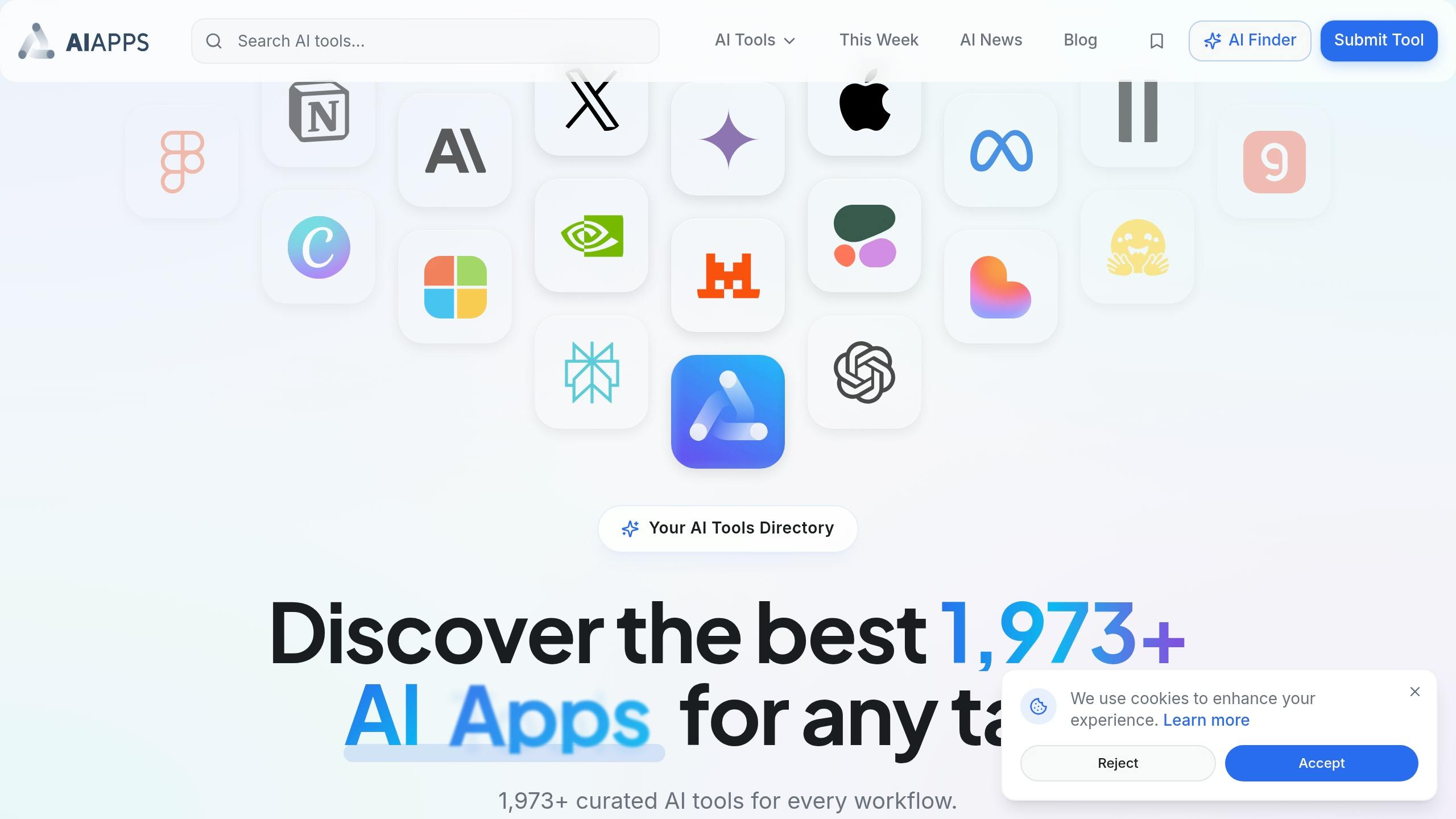
With over 27,000 AI tools available today, finding the perfect match for your needs can feel overwhelming. That’s where AI Apps steps in, offering a curated directory of more than 1,900 verified AI tools. Each tool undergoes a thorough multi-step verification process to ensure you’re accessing reliable, production-ready solutions - not outdated demos or abandoned projects.
The platform categorizes tools into specific groups like AI Text Generators, AI Art Generators, Presentation AI, and Enterprise Assistants, making it simple to find exactly what you’re looking for. Advanced filtering options allow you to search by use case, whether you need an AI Agent, a Coding Assistant, or a Data Analysis tool. Plus, data-driven rankings highlight which platforms are gaining momentum.
As competition heats up in the AI chatbot market - ChatGPT’s U.S. market share dropped from 57% to 42% between August 2025 and February 2026, while Google Gemini doubled its share to 25% - having a reliable directory is more important than ever. AI Apps stays on top of these changes, tracking new tools in real time, with some launches added as quickly as 24–48 hours after release.
How to Find Newly Launched Tools on AI Apps
AI Apps’ Latest AI Tools section is your go-to for spotting cutting-edge releases. Whether it’s tools like CompactifAI, which reduces model sizes by 95% for on-device usage, or platforms like Basis, recently valued at $1.15 billion, you can filter new tools by launch date, category, or pricing model to suit your needs.
When assessing tools, don’t just focus on download numbers. Tom Grant, VP of Research at Apptopia, advises, “The churn data is the real signal here... a 20 percentage point improvement in churn over seven months means users are finding sustained value”. AI Apps highlights this kind of retention data through its Featured Listings, which provide detailed traffic and engagement insights, helping you separate short-term hype from tools with lasting value.
| Feature | Free Listing | Featured Listing |
|---|---|---|
| Visibility | Standard placement | Priority in “Top-rated” and “Trending” areas |
| Verification | Basic verification | Multi-step verified badge |
| Analytics | Limited | Advanced traffic and engagement insights |
| Updates | Standard refresh cycle | Real-time update priority |
For startups and small businesses working within tight budgets, AI Apps’ pricing filters make it easy to find tools with freemium tiers or trial options. This allows you to test a tool’s value before committing to a subscription, whether it’s $10/month for a coding assistant or $59/month for enterprise writing tools. With global AI spending projected to hit $2.52 trillion by 2026, choosing the right tools early can be the difference between scaling efficiently and wasting resources on underperforming software.
Conclusion: What to Remember and What to Do Next
March 2026 marks a turning point in the world of AI. Apple's revamp of Siri with Gemini integration showcases a move toward edge-powered solutions that prioritize privacy. Meanwhile, OpenAI's staggering $110 billion funding round and $730 billion valuation underscore the industry's focus on scaling AI infrastructure. At the same time, Meta and AMD's $60 billion partnership to roll out a 6-gigawatt GPU network highlights the growing challenges around energy demands and computational capacity.
Agentic AI - systems capable of reasoning, planning, and autonomous execution - is reshaping how businesses operate. These advancements are driving down costs and increasing accessibility, opening the door for more businesses and creators to leverage sophisticated AI tools. However, this evolution isn't without its challenges. Block's decision to cut 40% of its workforce, impacting over 4,000 employees, demonstrates how automation is enabling leaner, more efficient teams.
"The conversational interface itself creates zero competitive advantage anymore. Stop investing engineering time building conversational interfaces that your competitors are also building." - Anna Kocsis, Mindset AI
This shift demands a more focused strategy for adopting AI. Instead of chasing every new model or trend, businesses and creators should concentrate on one or two core models, building structured workflows around them. Data readiness and observability should be key priorities. With 61% of senior leaders under intense pressure to show measurable returns on AI investments, establishing strong systems for tracking ROI from the outset is no longer optional - it's essential.
FAQs
How will Gemini integration change Siri day to day?
The Gemini integration is set to improve Siri's intelligence and responsiveness, allowing it to manage multi-step tasks more effectively and offer tailored responses. This upgrade aims to enhance everyday interactions, making Siri a more practical and intuitive assistant in daily life.
What’s the fastest way to use agentic AI at work?
The quickest route to integrating agentic AI into your workplace is by leveraging specialized tools from the 2026 AI agent boom. Platforms like CrewAI, OpenClaw, and enterprise solutions such as Domino's system are designed to help deploy, manage, and scale agentic AI with ease. These tools streamline the process, enabling businesses to incorporate AI-driven automation into their workflows without unnecessary complications.
When should I run AI on-device instead of the cloud?
Running AI directly on a device is perfect for situations where privacy, quick response times, or real-time interaction are critical. This includes things like professional tools, mobile applications, or managing sensitive information. Thanks to improvements in hardware, even large AI models can now function offline. This makes on-device AI not only faster but also more secure, as it reduces reliance on cloud services. It's an excellent option for those who prioritize privacy or need immediate processing capabilities.