Productivity
I Tested ChatGPT vs. Gemini vs. Grok vs. Claude in 2026 - Here’s the Only One Worth Paying For
Hands-on 2026 comparison of ChatGPT, Gemini, Grok, and Claude—pricing, context windows, coding accuracy, and why Claude Pro wins for professionals.
I Tested ChatGPT vs. Gemini vs. Grok vs. Claude in 2026 - Here’s the Only One Worth Paying For
In 2026, I compared ChatGPT, Gemini, Grok, and Claude to determine which AI tool is worth your money. Each excels in specific areas:
- ChatGPT: Best for general use, creative tasks, and coding with its memory feature and extensive ecosystem. Pricing starts at $20/month for Plus and $200/month for Pro.
- Gemini: Ideal for research with a 1-million-token context window and Google Workspace integration. Costs $19.99/month for Pro or $249.99/month for Ultra.
- Grok: Focused on real-time data and social media trends from X (formerly Twitter). Priced at $30/month for SuperGrok or $300/month for Heavy.
- Claude: Excels in coding and reasoning with a 200,000-token context window (1 million in beta). Pro plan is $20/month, with advanced tiers reaching $200/month.
Winner: Claude Pro at $20/month offers the best mix of accuracy, depth, and affordability, especially for professionals handling complex tasks. For casual users, ChatGPT remains a solid all-rounder.
ChatGPT: Performance Analysis and 2026 Pricing
What ChatGPT Does Well and Where It Falls Short
ChatGPT's GPT-5.2 model shines when it comes to creative tasks. It delivers engaging marketing copy and storytelling with a natural, conversational tone that resonates with users. Impressively, it leads the industry in abstract reasoning, scoring 52.9% on the ARC-AGI-2 benchmark, which measures its ability to tackle novel problems without prior examples. For developers, ChatGPT offers extensive language support and AI code tools for debugging, making it a dependable choice for quick coding projects.
One standout feature is its Memory capability, which is a game-changer for professional users. This feature remembers your preferences, past interactions, and technical details across sessions, saving you the hassle of repeatedly explaining your coding style or project requirements. As AI strategist Dave Goyal put it:
"GPT-5.1 still dominates mission-critical automation, where reliability and deterministic outputs matter more than creativity".
That said, ChatGPT does have its limitations. Its 128,000-token context window is smaller than what competitors offer - Claude supports 200,000 tokens, and Gemini can handle over 1 million. This restricts its ability to process large documents or extensive codebases effectively. Additionally, it occasionally generates "confident-sounding errors" and oversimplifies complex logic. On coding benchmarks, it scored 76.3% on SWE-bench Verified, falling just short of Claude's 77.2%. These factors highlight areas where improvements could enhance its utility further.
ChatGPT Pricing Tiers
ChatGPT's pricing structure reflects its diverse range of features and capabilities.
- The Free tier offers basic access to GPT-5.2, including limited voice features.
- The Go tier, priced at $8/month, provides expanded access but may include ads.
- The most popular option, ChatGPT Plus at $20/month, includes GPT-5.2 Thinking mode, DALL-E 4 for image generation, limited Sora video creation, and the Memory feature.
For power users, the Pro tier at $200/month is designed for developers and researchers. It offers unlimited access to OpenAI's most advanced models, including o1 and GPT-5.2 Pro mode, which comes with enhanced computational power for tackling complex problems. While the Plus tier meets general productivity needs, the Pro tier's steep price is justified only for those requiring maximum reasoning capabilities and expanded video generation features.
sbb-itb-212c9ea
Gemini: Context Size, Google Integration, and Pricing
Gemini's Advantages and Limitations
Gemini offers a 1-million-token context window, enabling it to process hundreds of pages in a single prompt. This makes it a strong option for handling complex tasks like analyzing extensive research papers, legal documents, or entire codebases without losing track of details. However, it no longer holds the top spot - Grok 4.x now supports a 2-million-token context window.
One of Gemini's standout features is its integration with Google Workspace, allowing seamless use within Gmail, Docs, Sheets, and other Google apps. Technology Evangelist Amresh Kumar highlights how this integration works directly within these platforms, enhancing productivity.
For example, Gap adopted Gemini Enterprise at $30 per user per month to improve product trend analysis. Other features like NotebookLM let users upload up to 50 source documents to build specialized expert systems, while the Audio Overview tool creates podcast-style summaries of lengthy documents.
However, Gemini does have its shortcomings. Users have reported inconsistent reasoning, surface-level search results, and delays when working with large files. Its coding accuracy, at 90%, falls short of ChatGPT's 95%. Additionally, API rates for Gemini 2.5 Pro increase significantly - from $1.25 to $2.50 per million input tokens - when prompts exceed 200,000 tokens.
These strengths and weaknesses shape Gemini's overall performance and are reflected in its pricing structure.
Gemini Pricing Tiers
Gemini's 2026 pricing model combines AI capabilities with cloud storage. The AI Pro subscription, priced at $19.99 per month, includes access to Gemini 3 Pro, Deep Research mode, and 2TB of cloud storage. This effectively brings the cost of the AI features to around $10.
For those needing higher limits, the AI Ultra tier costs $249.99 per month. It offers maximum usage for Deep Research, Veo 3 video generation (1080p, up to 100 videos monthly), 30TB of storage, and even a YouTube Premium subscription. On the enterprise side, the Gemini Enterprise plan at $30 per user per month caters to businesses requiring AI agent-building tools and CRM integrations.
A notable move in 2025 showcased Google's strategy for broader AI adoption. In partnership with Reliance Jio in India, Google provided 18 months of Gemini 2.5 Pro and 2TB of cloud storage free for subscribers. This bundle, valued at approximately $399, highlights how regional collaborations can drive mass adoption.
Grok: Real-Time Data and Conversational Performance
Grok's Conversational Capabilities
Grok 4.1 integrates seamlessly with X (formerly Twitter), pulling live posts, trending hashtags, and real-time sentiment data complete with timestamps. This makes it a standout choice for tracking current events. In performance tests, Grok delivered results in just 1.1 seconds, leaving competitors like Gemini Pro (2.5 seconds) and Claude (3.2 seconds) trailing behind.
Its conversational approach leans toward an edgy and witty tone, mimicking natural human interactions. As DataStudios puts it:
"Grok is the go-to for an experience that feels like a human conversation – full of tangents, humor, empathy – whereas ChatGPT is like conversing with a super-smart librarian".
In early 2026, a fintech content team leveraged Grok's real-time data feed to spot "AI credit scoring" as an emerging trend on social media. Acting quickly, they published an explainer article within 48 hours of identifying the trend, capturing 12,000 organic visitors in the first week. This highlights Grok's potential for first-mover advantage in fast-paced industries.
However, Grok isn't without its limitations. Its 128K token context window pales in comparison to ChatGPT's 2-million-token capacity or Gemini's 1-million-token window. Coding remains a weak spot - it struggles with edge cases and produces lower-quality outputs compared to competitors. Additionally, while its conversational tone is engaging, it may not be ideal for formal or professional tasks. Grok 4.1 also continues to falter with basic logic puzzles and riddles, an area where other tools excel.
Up next, let's break down Grok's pricing and how it ties into these features.
Grok Pricing Options
Grok's pricing reflects its evolution from an X-exclusive feature to a standalone AI service. The SuperGrok plan is priced at $30 per month or $300 annually. This plan includes access to Grok 4, DeepSearch mode, Think Mode, and unlimited AI image generation. However, at $30 per month, it costs 50% more than the standard $20 rate of similar plans.
For power users, there's the SuperGrok Heavy plan at $300 per month. This tier offers Grok 4 Heavy (which achieved a perfect score on the AIME 2025 mathematics benchmark), a 256K context window, and up to 500 video renders daily. A free tier is also available, allowing roughly 10 requests every two hours. While useful for casual exploration, the limitations make it impractical for consistent use. Additionally, the X Premium+ plan at $40 per month combines Grok functionality with social media perks like ad-free browsing and monetization options.
The pricing leaves little room for broad appeal. As AI Tool Analysis notes:
"SuperGrok at $30/month is specifically designed for people who want Grok's AI capabilities without caring about Twitter's social features".
If your focus is on tracking real-time social trends or breaking news, Grok delivers on its promise. But for tasks like coding, professional-grade writing, or advanced reasoning, you're paying a premium for a tool that doesn’t quite measure up - an important factor when weighing its ROI and alignment with your needs.
Claude: Advanced Reasoning and Extended Context
Claude's Performance in Complex Tasks
Claude stands out for its ability to handle complex tasks thanks to its extended context and reasoning capabilities. The latest version, Claude Opus 4.6, launched on February 5, 2026, boasts a massive 200,000-token context window. This allows it to process extensive materials like entire codebases, technical books, or lengthy conversation logs in one go. Even more impressively, a beta version offers a 1-million-token window, capable of managing approximately 2,500 pages of text. These features make it a strong choice for tasks like refactoring legacy code or debugging intricate logic issues.
In coding benchmarks, Claude has shown impressive results, reducing code revisions by 40% during software development tests. Its Adaptive Thinking Mode lets users adjust reasoning depth - Low for quick responses and Max for detailed analysis. This flexibility contributes to its low hallucination rate of just 1%, far outperforming ChatGPT's 16% and Gemini's 12%. Vinod Chugani, a data science expert, highlights its capabilities:
"Claude Opus 4.5 currently leads in coding benchmarks... It's strong at tasks requiring sustained reasoning across multiple files, like refactoring legacy code or debugging subtle logic errors".
However, this depth comes at the cost of speed. Claude averages 4.8 seconds per response, significantly slower than ChatGPT's 2.1 seconds and Gemini Flash's 1.2 seconds. While this delay can be frustrating for quick interactions or simple queries, it’s a worthwhile trade-off for professionals tackling intricate debugging or architectural challenges. Claude doesn’t just provide fixes - it explains issues and offers thoughtful improvements. For those prioritizing precision and depth, Claude remains a top-tier choice, excelling in scenarios where accuracy outweighs speed.
Claude Pricing Tiers
Claude’s pricing reflects its premium positioning, catering to professionals who need advanced tools. The Pro plan is priced at $20 per month (or $17 per month with annual billing), offering 5× more usage than the free tier and access to all models, including Opus 4.6. For heavy users, the Max (5×) plan costs $100 per month, delivering 5× the Pro usage limits along with priority access during high-traffic periods. The Max (20×) plan, at $200 per month, offers 20× Pro usage and early access to experimental features.
For teams, the Team plan is available at $25 per user per month (billed annually) or $30 per user for monthly billing, with a minimum of five users. Developers requiring full CLI and terminal access can opt for the Team (Premium) plan, priced at $150 per user per month. API pricing starts at $5 per million input tokens and $25 per million output tokens for Opus 4.6.
At $20 per month, Claude Pro aligns with standard pricing for similar plans. However, its slower speed and lack of persistent memory may make it less appealing for casual users. For professionals working on complex coding, document analysis, or tasks demanding precision, Claude’s pricing is well-matched to its capabilities. Its accuracy and extended context features justify the cost, especially for those who value depth over speed.
ChatGPT 5 VS Gemini VS Claude VS Grok - The Ultimate Test
Side-by-Side Comparison of All 4 Tools
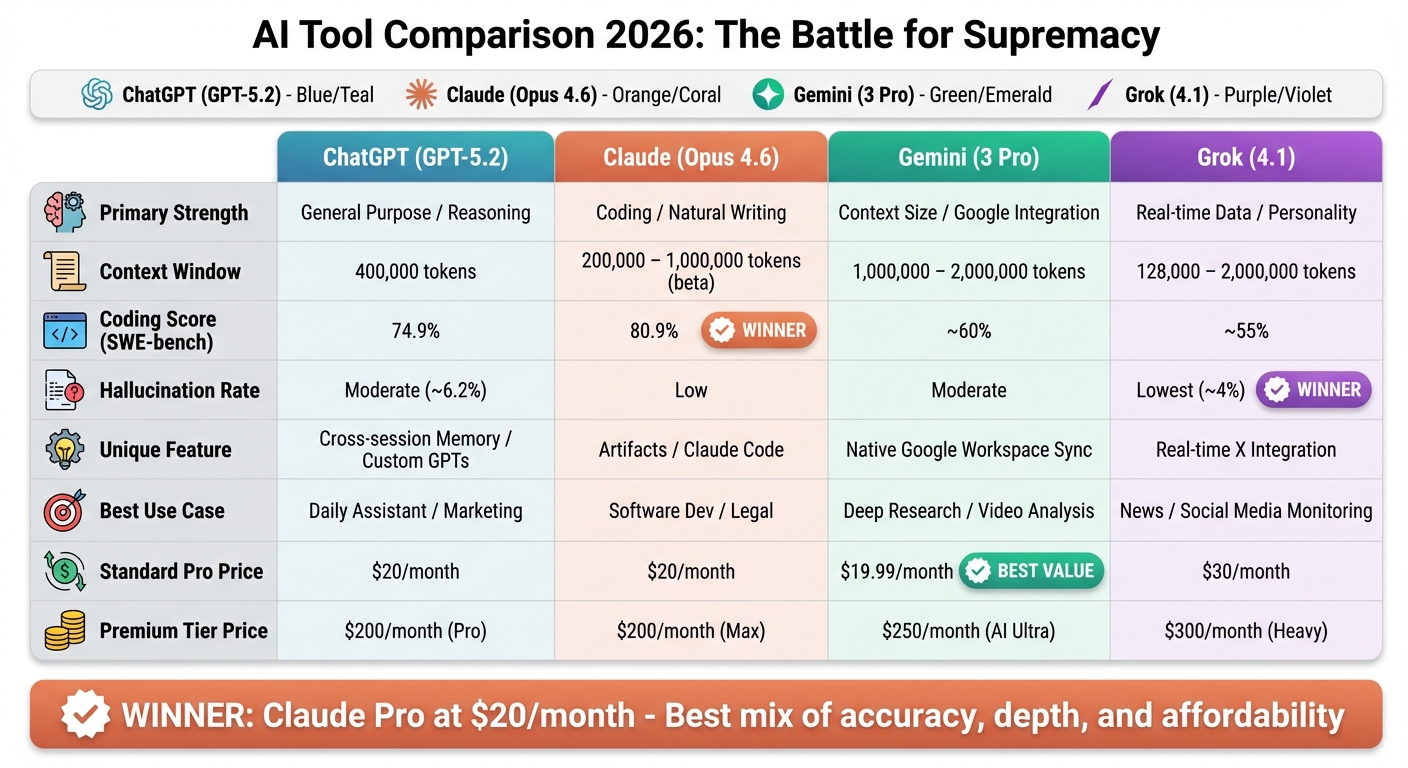
ChatGPT vs Claude vs Gemini vs Grok 2026 Comparison
Feature and Pricing Comparison Table
Through detailed testing, it’s clear that these four AI tools - ChatGPT, Claude, Gemini, and Grok - each excel in distinct areas. Choosing the one that delivers the best return on investment in 2026 depends on how their unique strengths align with your specific needs.
Here’s a breakdown of their features, performance, and pricing:
| Feature | ChatGPT (GPT-5.2) | Claude (Opus 4.6) | Gemini (3 Pro) | Grok (4.1) |
|---|---|---|---|---|
| Primary Strength | General Purpose / Reasoning | Coding / Natural Writing | Context Size / Google Integration | Real-time Data / Personality |
| Context Window | 400,000 tokens | 200,000 – 1,000,000 tokens (beta) | 1,000,000 – 2,000,000 tokens | 128,000 – 2,000,000 tokens |
| Coding Score (SWE-bench) | 74.9% | 80.9% | ~60% | ~55% |
| Hallucination Rate | Moderate (~6.2%) | Low | Moderate | Lowest (~4%) |
| Unique Feature | Cross-session Memory / Custom GPTs | Artifacts / Claude Code | Native Google Workspace Sync | Real-time X Integration |
| Best Use Case | Daily Assistant / Marketing | Software Dev / Legal | Deep Research / Video Analysis | News / Social Media Monitoring |
| Standard Pro Price | $20/month | $20/month | $19.99/month | $30/month |
| Premium Tier Price | $200/month (Pro) | $200/month (Max) | $250/month (AI Ultra) | $300/month (Heavy) |
This table highlights the strengths and pricing of each tool, helping you decide which one fits your workflow best. For those building a business, choosing the best AI tools for entrepreneurs can significantly streamline operations.
ChatGPT is the all-around performer, ideal for a variety of tasks but not necessarily the top choice for specialized needs. Claude shines in coding, achieving an 80.9% score on SWE-bench and maintaining a low hallucination rate. Gemini is a powerhouse for handling vast amounts of data, with a context window stretching up to 2,000,000 tokens. Meanwhile, Grok carves out its niche with real-time integration with X (formerly Twitter) and a conversational user experience.
Each of these tools is designed to address specific challenges - whether you’re looking for precision in coding, the ability to analyze massive documents, a general productivity booster, or a tool for tracking real-time trends and social media activity.
Which AI Tool Is Worth Paying For in 2026
The Winner Based on Testing Results
After thorough testing across areas like coding, writing, research, and real-time applications, Claude (Opus 4.5) stands out as the top choice for 2026. This conclusion comes from evaluating performance across multiple key dimensions.
Claude shines particularly for developers, writers, and legal professionals. Its natural, conversational tone requires minimal tweaking for content creation, and its coding capabilities outpace its competitors. For those looking for versatility, ChatGPT remains a dependable option. Its extensive plugin ecosystem and persistent memory make it a strong all-around performer. Meanwhile, researchers and users in the Google Workspace ecosystem might find Gemini worth its $19.99/month price, thanks to its massive 1-million-token context window and the ability to process lengthy, 2-hour videos in one go.
For businesses, the smartest move is assigning specific AI models to specific tasks instead of relying on a single subscription. This approach aligns with the growing trend of intelligent orchestration. For professional work that demands accuracy, Claude Pro at $20/month offers an excellent mix of performance and affordability.
Find More AI Tools on AI Apps
While these four major players dominate the spotlight, there are hundreds of specialized AI tools designed for specific industries and workflows. Whether you're looking for AI video editing tools, customer support, data analysis, or other niche applications, exploring a curated directory can help you pinpoint the right tool.
AI Apps provides a searchable catalog of over 1,900 AI tools organized into categories like AI Art Generators, AI Text Generators, and AI Video Tools. The platform includes advanced filtering options, highlights new releases, and features both free and paid tools. If you're developing an AI product, you can even submit your tool for inclusion through their verification process.
Check out AI Apps to discover tools that complement the options mentioned here and find solutions tailored to your unique needs.
FAQs
Which $20/month plan is best for my work: ChatGPT Plus or Claude Pro?
Both $20/month plans serve distinct purposes. ChatGPT Plus shines in general tasks, creative writing, coding, and web browsing, offering flexibility for a variety of needs. On the other hand, Claude Pro is more suited for coding, analyzing lengthy documents, and creating detailed, nuanced content - perfect for technical or complex projects. Opt for ChatGPT Plus if you need a tool for diverse productivity, or go with Claude Pro for specialized, deep-dive work.
Do I need a 1,000,000-token context window, or is 200,000 enough?
For most tasks in 2026, a 200,000-token context window typically gets the job done. Opting for a 1,000,000-token window only makes sense if you're dealing with extremely lengthy documents or intricate research that demands a vast amount of context. It's best to assess your specific requirements before choosing the larger option.
When is it worth paying extra for real-time X data in Grok?
Paying a little extra for real-time X data in Grok can make a big difference when your work - whether it’s research, analysis, or decision-making - calls for the latest and most accurate information. Having real-time access ensures you're working with up-to-the-minute data, which is especially important in scenarios where relying on outdated information could lead to less effective outcomes.