
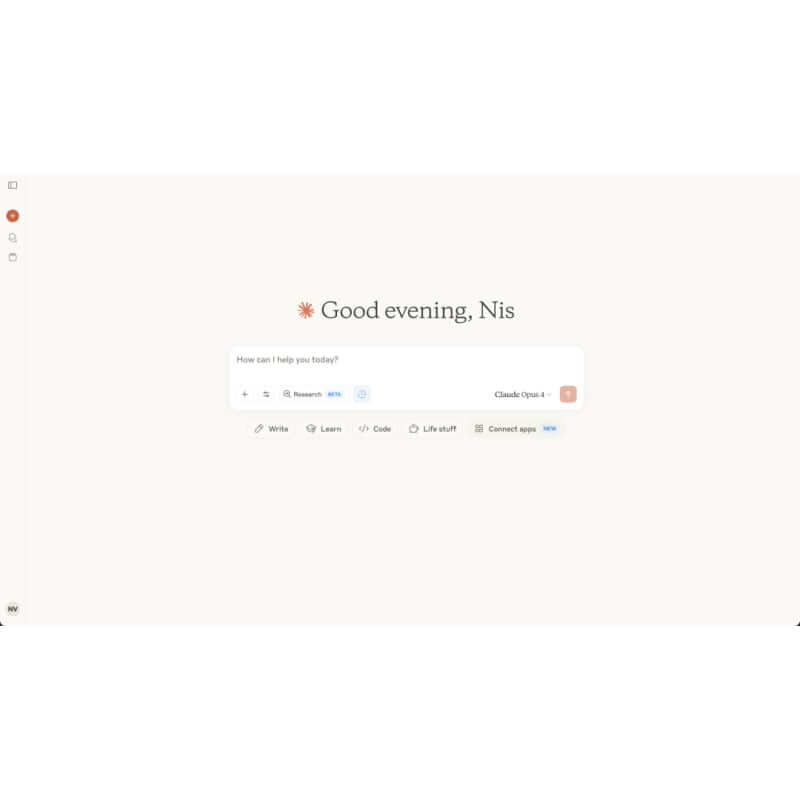
Claude Opus 4 is an Automation tool. Claude Opus 4 is an AI tool that handles complex tasks and solves problems on its own. Key features include Extended Thinking with Tool Use, Advanced Agentic Capabilities, and Improved Steerability. Best for teachers, marketers and content creators.
About Claude Opus 4
Claude Opus 4 is Anthropic's flagship Claude model tuned for complex, multi-step work: code generation that maintains context across long sessions, research that involves coordinating multiple tools, and decision-making that benefits from extended reasoning. The positioning is the high-effort end of the Claude family, where time-to-answer matters less than answer quality.
The core features that matter
- Extended thinking with tool use that combines deep reasoning with external tool integration, producing more accurate and well-considered responses than models that reason without tools or use tools without thinking
- Advanced agentic capabilities that let the model decide and execute next steps in a task autonomously, allowing it to work continuously on complex projects for extended periods
- Improved steerability for handling long, detailed instructions reliably, producing output that hews to specifications rather than drifting
- Parallel tool calling for using multiple tools concurrently rather than sequentially, completing complex workflows in fewer total steps
- Sophisticated organizational knowledge processing across diverse data types for research, analysis, and content creation at scale
- High-level AI agent powering designed for the more demanding agent workloads where simpler models hit their limits on context and reasoning depth
How it stands out
The frontier LLM space has three serious players: OpenAI's GPT-4/5 line, Anthropic's Claude, and Google's Gemini, plus smaller competitors. Claude Opus 4 differentiates on a specific cluster of capabilities: long-horizon agent work, code generation in complex codebases, and instruction-following with intricate or layered requirements. For tasks that benefit from those specific strengths, Claude Opus 4 delivers strong results. For shorter, simpler tasks, the smaller Claude models (Sonnet, Haiku) often work fine at lower cost.
The honest qualifier: choosing between frontier LLMs depends heavily on the specific tasks you run. Benchmarks and user reports suggest Claude Opus 4 has edges on certain categories, particularly code, agent work, and following intricate instructions, but other categories may favor competitors. For users committed to one platform, Claude Opus 4 is Anthropic's strongest offering. For users open to model-mixing, comparing on specific use cases matters more than picking a default.
Key Features
Extended Thinking with Tool Use.
Advanced Agentic Capabilities.
Improved Steerability.
Parallel Tool Calling.
Sophisticated Organizational Knowledge Processing.
High-Level AI Agent Powering.
Frequently Asked Questions
Claude Opus 4 is a smart AI that's really good at figuring things out. It helps AI assistants do more on their own, like solving problems and working for a long time. It's like giving AI a brain boost!
With Claude Opus 4, you can have computers handle tough tasks without you. It's good at making decisions, working with different computer programs, and looking at lots of information. It's like having a super-smart helper for work or research.
Claude Opus 4 has some cool features. It can use different tools to get things done, make its own choices, and follow long instructions easily. It can also use several tools at once and understand lots of information. It's perfect for making really smart AI assistants.
Claude Opus 4 was created to make AI assistants better at handling complicated projects that take a long time. It improves their ability to think, keep working, and use different tools, which helps boost productivity. It's a big step forward for AI!