Digital Transformation
Claude Opus 4.7 vs ChatGPT 5.5 - Features & Full Review
A focused comparison of two leading AI models, revealing which one excels at coding, research, vision, and cost.
Claude Opus 4.7 vs ChatGPT 5.5 - Features & Full Review
Choosing between Claude Opus 4.7 and ChatGPT 5.5 depends on your specific needs. Both models excel in different areas:
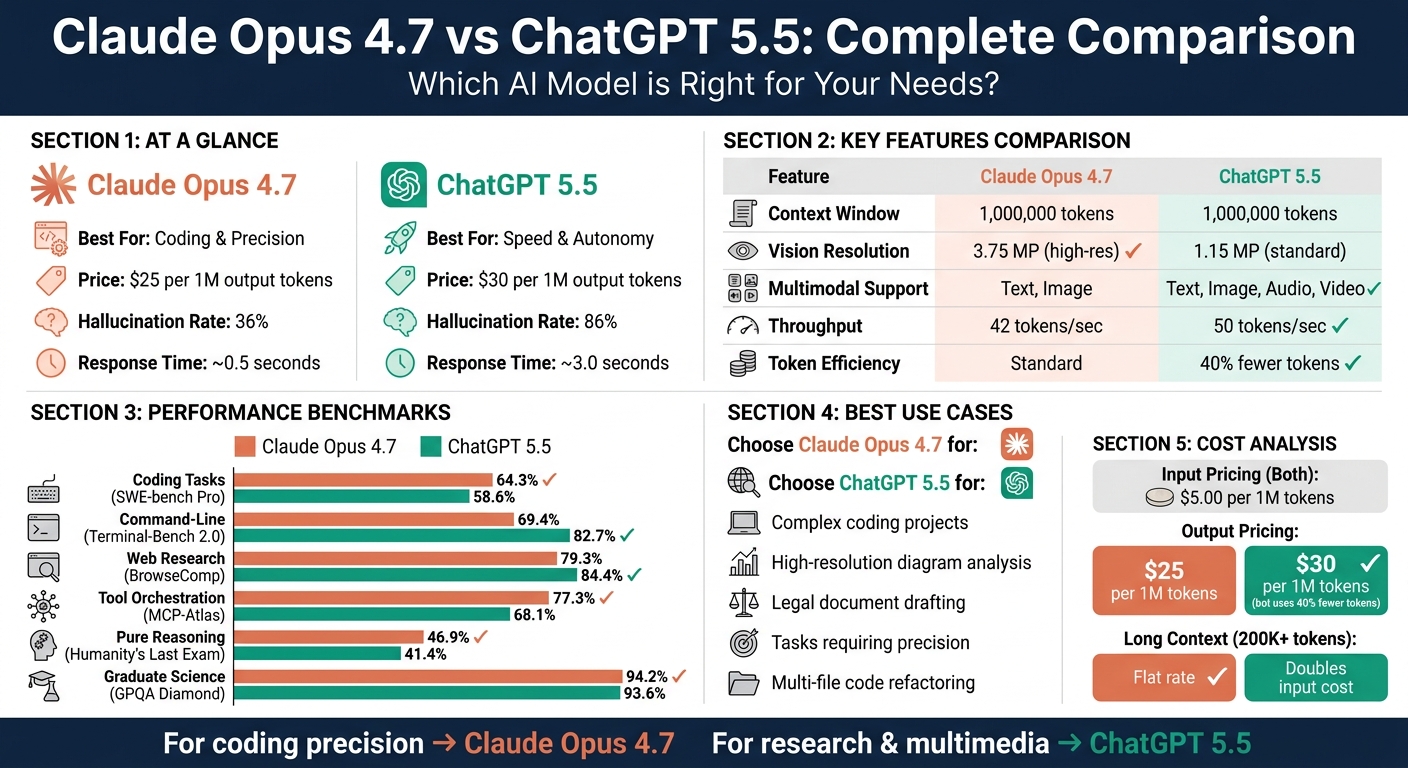
- Claude Opus 4.7: Best for coding-heavy tasks, precise document analysis, and handling high-resolution images. It offers a 1M token context window, advanced reasoning, and fast response times. Pricing is $25 per 1M output tokens.
- ChatGPT 5.5: Ideal for autonomous workflows, web research, and multimedia tasks. It uses fewer tokens per task, supports audio and video, and excels in browsing tasks. Pricing is $30 per 1M output tokens.
Quick Comparison
| Feature | Claude Opus 4.7 | ChatGPT 5.5 |
|---|---|---|
| Primary Strength | Coding & precision | Speed & autonomy |
| Context Window | 1,000,000 tokens | 1,000,000 tokens |
| Vision Resolution | 3.75 MP (high-res) | 1.15 MP (standard) |
| Multimodal Support | Text, Image | Text, Image, Audio, Video |
| Output Pricing | $25 per 1M tokens | $30 per 1M tokens |
| Hallucination Rate | 36% | 86% |
| Coding Benchmark | 64.3% (SWE-bench Pro) | 58.6% |
| Web Research | 79.3% (BrowseComp) | 89.3% |
For coding precision and technical tasks, go with Claude Opus 4.7. For research, multimedia, and autonomous workflows, ChatGPT 5.5 is the better choice.
Claude Opus 4.7 vs ChatGPT 5.5: Feature Comparison and Performance Benchmarks
Claude Opus 4.7 Overview
Core Features
Claude Opus 4.7 introduces a feature called adaptive thinking, which adjusts the depth of reasoning based on the task's complexity. Developers can activate this by including thinking: {type: "adaptive"} in API calls.
The model also boasts a massive 1M token context window, allowing it to process extensive datasets, entire codebases, or lengthy documents without additional costs. Complementing this is the new xhigh effort level, which balances deep reasoning for complex coding tasks with efficient performance.
In terms of visual capabilities, Claude Opus 4.7 now supports high-resolution images up to 2,576 pixels (3.75MP), three times higher than before. It excels at interpreting dense charts, UI designs, and technical diagrams, achieving a 98.5% score on visual acuity benchmarks - up from 54.5% in Opus 4.6.
Another feature in beta is task budgets, which lets developers set an advisory token ceiling for entire agentic loops. This helps the model prioritize tasks and complete them efficiently. Additionally, the model includes self-check mechanisms during multi-step workflows, reducing errors by aligning outputs with the original instructions.
However, the updated tokenizer, while improving performance, increases token usage by 1.0× to 1.35× compared to Opus 4.6. These features make it a powerful tool for various applications, as outlined below.
Strengths and Applications
Claude Opus 4.7 shines in agentic coding tasks, handling long-running and autonomous software engineering projects with ease. Its performance improvements translate directly into real-world results.
For instance, Rakuten reported in April 2026 that Opus 4.7 resolved three times more production tasks than its predecessor, with noticeable improvements in both code quality and testing. Notion’s AI team saw a 14% boost in performance while using fewer tokens and experiencing significantly fewer tool errors. Linear also reported a 13% lift in task resolution rates on a 93-task internal coding benchmark, successfully addressing challenges that earlier models struggled with.
The model isn’t limited to coding. It performs exceptionally well in enterprise knowledge work, leading the GDPVal-AA benchmark with an Elo score of 1,753, outpacing GPT-5.4's 1,674. For legal analysis, it scored 90.9% on the BigLaw Bench, and in financial modeling, it achieved 64.4% on Finance Agent v1.1. Databricks also noted a 21% reduction in errors when using Opus 4.7 for document understanding tasks.
"Claude Opus 4.7 feels like a real step up in intelligence. Code quality is noticeably improved, it's cutting out the meaningless wrapper functions and fallback scaffolding that used to pile up, and fixes its own code as it goes."
- Ben Lafferty, Senior Staff Engineer, Shopify
The 1M token context window is a game-changer for multi-file refactoring, enabling the model to load and reason across entire repositories. It has been noted for maintaining coherence across 40+ files simultaneously. Solve Intelligence confirmed in April 2026 that the model successfully interpreted complex chemical structures, a task that earlier versions mishandled.
Limitations
Despite its strengths, Claude Opus 4.7 has some drawbacks. Its performance in web research has declined, with BrowseComp scores dropping to 79.3% from 83.7% in Opus 4.6, trailing competitors like GPT-5.4 Pro (89.3%) and Gemini 3.1 Pro (85.9%).
The model’s precise execution can sometimes lead to overly literal interpretations. Prompts designed for earlier versions may need rephrasing to avoid overly rigid outputs. Additionally, the updated tokenizer increases token usage by up to 35%, potentially raising costs. Pricing remains at $5 per 1M input tokens and $25 per 1M output tokens.
To address hallucinations, the model now abstains from responding more often, reducing the attempt rate to 70% (down from 82% in Opus 4.6). This has lowered the hallucination rate from 61% to 36%.
Developers should also note API changes. Non-default sampling parameters (like temperature, top_p, and top_k) now trigger errors, and thinking blocks are omitted from API responses by default. Without setting the display parameter to "summarized", this can cause long pauses before outputs begin.
sbb-itb-212c9ea
ChatGPT 5.5 Overview
Core Features
ChatGPT 5.5 marks a major step forward, being the first fully retrained model since GPT-5.4 (also known as "Spud"). It brings substantial improvements in reasoning and handling long contexts.
One standout feature is its expanded context window: 1,000,000 tokens for API developers and 400,000 tokens in Codex. This enhancement boosts retrieval accuracy significantly, from 36.6% to 74.0% for inputs in the 512K–1M token range.
The model introduces a unified architecture that dynamically assigns tasks based on complexity. Simpler tasks are handled by a faster model, while more complex ones are routed to a deeper reasoning module called GPT-5.5 Thinking. It also uses reinforcement learning to refine its reasoning process, reducing errors and improving strategy development.
Another key capability is its agentic AI functionality, which allows it to autonomously navigate software, manage tools, and complete multi-step tasks with minimal human input. On top of that, it’s designed to be more efficient, using 40% fewer output tokens compared to GPT-5.4, while increasing the likelihood of factually correct responses by 23%.
Pricing for the standard API tier is set at $5.00 per 1M input tokens and $30.00 per 1M output tokens. These advancements position ChatGPT 5.5 as a powerful tool for a wide range of applications.
Strengths and Applications
The technical upgrades in ChatGPT 5.5 translate directly into better performance across various real-world tasks. It excels in agentic workflows and autonomous task execution, achieving 82.7% accuracy on Terminal-Bench 2.0, a benchmark for command-line interface tasks. In OSWorld-Verified, which measures autonomous performance in real computing environments, it scored 78.7%.
In the realm of scientific and mathematical reasoning, ChatGPT 5.5 Pro outperformed competitors, scoring 39.6% on FrontierMath Tier 4 - almost double the score of Claude Opus 4.7, which achieved 22.9%. It also led the Artificial Analysis Intelligence Index with a score of 60. For knowledge work, it demonstrated its versatility by scoring 84.9% on the GDPval benchmark, which evaluates proficiency across 44 professions. In legal analysis, it achieved 91.7% overall on Harvey AI’s BigLaw Bench, with 43% of its responses deemed perfect.
"GPT-5.5 is noticeably smarter and more persistent than GPT-5.4, with stronger coding performance and more reliable tool use."
- Michael Truell, Co-founder & CEO at Cursor
Practical applications further highlight its capabilities. For example, OpenAI's finance team used GPT-5.5 in April 2026 to review 24,771 K-1 tax forms spanning 71,637 pages, completing the task two weeks faster than the previous year. NVIDIA also leveraged GPT-5.5 to accelerate debugging processes, cutting down time from days to hours by deploying it on NVIDIA GB200 NVL72 systems. At Jackson Laboratory for Genomic Medicine, it helped analyze a gene-expression dataset with 62 samples and nearly 28,000 genes, generating a research report in a fraction of the time it would typically take.
"It's more than faster coding - it's a new way of working that helps people operate at a fundamentally different speed."
- Justin Boitano, VP of Enterprise AI at NVIDIA
Even in document processing, ChatGPT 5.5 has proven its efficiency. Box reported a significant improvement in document extraction tasks, reducing processing time from 46 seconds to 12 seconds - a 74% speed increase.
Limitations
While ChatGPT 5.5 brings impressive advancements, it does have some notable shortcomings. The model has a higher hallucination rate than its competitors, scoring 86% on the AA-Omniscience benchmark, compared to Claude Opus 4.7’s 36%. This means it is more prone to confidently generating incorrect information when it lacks the right data.
In complex software engineering tasks, it falls short of its rivals. On SWE-bench Pro, which evaluates the ability to resolve multi-file issues in codebases, ChatGPT 5.5 scored 58.6%, lagging behind Claude Opus 4.7’s 64.3%.
The model also struggles with mid-range context retrieval. While it excels at the extremes of its context window, its accuracy drops to 91% in the 16K–64K token range, compared to 93% in GPT-5.4.
Another limitation is its modality restrictions. Although marketed as part of an omnimodal ecosystem, GPT-5.5 natively handles only text and image inputs, producing text-only outputs. Audio and video processing are supported at the product level but not directly by the model.
Finally, the model often agrees with user statements without proper verification, which can be problematic for fact-critical tasks like legal or medical analysis. Users are advised to independently verify claims made by GPT-5.5 to avoid relying on potentially incorrect information.
Feature Comparison
Feature Comparison Table
Claude Opus 4.7 is designed for deep reasoning and precise adherence to instructions, while ChatGPT 5.5 focuses on speed, autonomous tool handling, and multimodal capabilities.
| Feature | Claude Opus 4.7 | ChatGPT 5.5 |
|---|---|---|
| Primary Strength | Deep reasoning & literal following | Speed & autonomous tool loops |
| Time-to-First-Token | ~0.5 seconds | ~3.0 seconds |
| Throughput | ~42 tokens per second | ~50 tokens per second |
| Context Window | 1,000,000 tokens | 1,000,000 tokens |
| Vision Resolution | 3.75 MP (2,576px long edge) | ~1.15 MP (standard) |
| Multimodal Support | Text, Image | Text, Image, Audio, Video |
| API Pricing (Output) | $25.00 per 1M tokens | $30.00 per 1M tokens |
| Long Context Surcharge | Doubles at 200K+ tokens | Flat rate across all contexts |
Benchmark tests highlight Claude's strength in coding precision, while ChatGPT shines in command-line automation.
Key Differences
The primary distinction lies in their approach: deep reasoning versus rapid execution. Claude Opus 4.7 uses a structured "Plan → Execute → Verify → Report" loop, minimizing errors and making it ideal for tasks requiring high accuracy, such as legal analysis, scientific studies, or intricate code reviews.
"One model moves faster. The other thinks deeper."
- Opinion AI
On the other hand, ChatGPT 5.5 excels in agentic loops, where it autonomously plans, executes, and corrects errors. It achieved 41.4% on Humanity's Last Exam compared to Claude's 46.9%, but its higher throughput and efficient token usage make it better suited for extended tasks.
Vision capabilities further differentiate the two. Claude Opus 4.7 processes images with up to 3.75 megapixels, enabling it to interpret dense UI elements with 98.5% visual accuracy. ChatGPT 5.5, while limited to lower-resolution images, compensates with integrated audio and video support, thanks to its unified architecture.
Another standout feature of ChatGPT 5.5 is mid-response steerability, allowing users to adjust the model's plan mid-task. Claude Opus 4.7, however, emphasizes literal instruction-following and offers configurable "effort levels" (low, medium, high, xhigh, max), enabling users to balance reasoning depth with response speed.
"Opus 4.7's leads cluster on reasoning-heavy and review-grade tests; GPT-5.5's leads cluster on long-running tool-use and shell-driven tasks."
- LLM Stats
These differences provide a clear framework for assessing their strengths and determining which model suits specific use cases.
Performance Benchmarks and Test Results
Benchmark Results
Both models were tested against seven industry-standard benchmarks, focusing on coding, reasoning, tool usage, and research. The results highlight distinct areas of strength: Claude Opus 4.7 excels in reasoning-intensive and coding tasks, while ChatGPT 5.5 shines in autonomous tool loops and web research.
| Benchmark | Claude Opus 4.7 | ChatGPT 5.5 | Category |
|---|---|---|---|
| SWE-bench Pro (Coding) | 64.3% | 58.6% | Repository bug fixing |
| Terminal-Bench 2.0 (Shell) | 69.4% | 82.7% | Command-line automation |
| GPQA Diamond (Reasoning) | 94.2% | 93.6% | Graduate-level science |
| BrowseComp (Research) | 79.3% | 84.4% | Multi-step web browsing |
| MCP-Atlas (Tool Use) | 77.3% | 68.1% | API orchestration |
| OSWorld-Verified (Computer Use) | 78.0% | 75.0% | Desktop automation |
| Humanity's Last Exam (HLE) | 46.9% | 41.4% | Pure reasoning (no tools) |
Claude Opus 4.7 demonstrates an edge in SWE-bench Pro, with a 5.7-point lead, and dominates MCP-Atlas by 9.2 points, showcasing its expertise in multi-file code refactoring and tool orchestration. For those needing to build custom agents, tools like Mixus can further streamline these workflows. On the other hand, ChatGPT 5.5 outperforms in Terminal-Bench 2.0 with a 13.3-point advantage, as well as in BrowseComp, where it leads by 5.1 points, making it a strong contender for shell-based workflows and detailed web research.
For GPQA Diamond, the models are nearly tied at 94.2% and 93.6%, indicating that both have reached advanced levels in graduate-level reasoning tasks. However, Claude's 46.9% score on Humanity's Last Exam surpasses ChatGPT's 41.4%, highlighting its stronger raw reasoning abilities without tool assistance. These benchmarks provide a solid foundation for evaluating real-world enterprise applications.
Test Scenarios
The benchmarks translate into noticeable performance advantages in practical use cases. Claude Opus 4.7, for example, supports 3.75-megapixel resolution (2,576 pixels on the long edge), achieving a 98.5% visual accuracy score, which is ideal for handling intricate technical diagrams.
ChatGPT 5.5, meanwhile, uses 40% fewer output tokens , making it more efficient for lengthy tasks, even though its 3-second Time-to-First-Token (TTFT) is slower. Additionally, its factual accuracy has improved, with individual claims being 33% less likely to be false compared to its earlier version.
"If you're building an IDE assistant or a chat surface where users care about how fast the first word appears, Opus 4.7's sub-second TTFT wins."
- LLM Stats
Strengths, Weaknesses, and Best Uses
Comparison Table
Here's a breakdown of the strengths, weaknesses, and ideal applications for each model, based on benchmark tests and practical use cases:
| Aspect | Claude Opus 4.7 | ChatGPT 5.5 |
|---|---|---|
| Primary Strengths | Advanced coding capabilities, multi-tool integration, high-resolution vision (3.75 MP), and fast response times | Autonomous workflows, web research, efficient token usage, and multimedia integration (DALL-E 3) |
| Key Weaknesses | Struggles with long-context retrieval (MRCR dropped to 32.2%), higher token consumption, and a tendency to argue | Slower initial response (~3 seconds), less effective with multi-file coding, lower visual resolution, and occasional overly agreeable behavior |
| Best For | Coding projects, legal document drafting, diagram analysis, and interactive chat applications | Research tasks, data pipeline creation, image generation, and consumer-facing voice tasks |
| Avoid For | Handling documents with over 800 lines or high-volume processing exceeding 200K tokens | Complex environments with multiple tools or coding tasks that demand high precision and human oversight |
| Cost Efficiency | $25 per 1M output tokens with a flat rate across a 1M-token context | $30 per 1M output tokens but uses about 40% fewer tokens per task |
These insights provide a clear view of how each model performs in different scenarios.
Claude Opus 4.7 shines when precision and speed are priorities. However, its ability to handle long-context tasks has dropped significantly - from 78.3% to 32.2% - making it less suitable for processing extensive documents or large codebases.
ChatGPT 5.5, on the other hand, is designed for autonomous workflows and excels in token efficiency, which helps mitigate its slightly higher per-token cost. However, it tends to produce more formatting errors in multi-API settings.
"Opus 4.7 is an upgrade specifically for 'coding Agents,' and for all other scenarios, it's a downgrade."
- APIYI Technical Team
How to Choose
Based on their performance and use cases, here's how to decide which model works best for your needs:
- Choose Claude Opus 4.7 if your focus is on complex coding projects, creative writing, or tasks requiring fast response times. Its 98.5% accuracy in visual tasks makes it ideal for analyzing detailed diagrams or high-resolution images. However, for tasks involving lengthy document analysis - like contract reviews - the older Opus 4.6 remains a more reliable choice.
- Go with ChatGPT 5.5 for workflows involving image generation, autonomous research, or high-volume processing. Its token efficiency (saving roughly 40%) and batch discounts (up to 50% on non-urgent tasks) make it a cost-effective option. For creating structured content like listicles or how-to guides, ChatGPT offers quicker results, while Claude is better suited for producing more natural, conversational prose .
It's worth noting that 54% of enterprise developers prefer Claude for coding tasks, while ChatGPT remains the go-to for browser-based research.
I Tested ChatGPT vs Claude's Latest Models So You Don't Have To
Conclusion
As of April 2026, both Claude Opus 4.7 and ChatGPT 5.5 represent the forefront of AI advancements, excelling in unique areas. Claude Opus 4.7 shines in agentic coding and multi-tool orchestration, while ChatGPT 5.5 takes the lead in autonomous web research and browsing. Benchmark data highlights Claude's superior performance in coding tasks and ChatGPT's strength in web research capabilities . Additionally, Claude's enhanced vision capabilities make it particularly effective for analyzing high-resolution images, technical diagrams, and blueprints.
These differences have practical implications for both cost and performance. Both models charge $5.00 per 1M input tokens, but their output pricing varies: ChatGPT 5.5 costs $30.00 per 1M tokens, compared to Claude's $25.00. However, OpenAI asserts that ChatGPT uses about 40% fewer output tokens to complete similar tasks . For enterprises working with extensive documents exceeding 272K tokens, Claude offers consistent flat pricing within its 1M-token context window. In contrast, ChatGPT doubles its input costs at that threshold.
The choice between these models should hinge on your specific operational priorities. For tasks like complex software engineering, front-end development, high-resolution document analysis, or projects requiring precise formatting, Claude Opus 4.7 is the better fit. On the other hand, ChatGPT 5.5 excels in market research, creative image generation, and workflows demanding flexible reasoning . As Timothy Beck Werth from Mashable puts it:
"Claude Opus 4.7 has an edge on advanced and agentic coding, but GPT-5.5 performs better on most benchmarks".
For many professionals, the most effective approach isn't choosing one model exclusively but using both strategically. By integrating these models into a routing system tailored to specific tasks, users can maximize their strengths while managing costs efficiently. This hybrid strategy allows professionals to leverage the best of both worlds.
Explore More AI Tools on AI Apps
Looking to expand your AI toolkit? AI Apps offers a directory of over 1,900 AI tools, covering everything from coding and vision analysis to creative workflows and professional research. This comprehensive collection simplifies the process of finding the perfect tool for your specific needs.
The directory features powerful search tools that make it easy to discover cutting-edge models and specialized solutions tailored to your requirements. With categories organized by use case, you can quickly compare tools for tasks like reasoning, image generation, or document analysis. If you're integrating AI into workflows for coding or research, this resource provides targeted options designed to address those exact needs.
For developers, there’s an opportunity to showcase tools through a submission portal, connecting with professionals actively seeking innovative solutions. To maintain high standards, the platform uses a multi-step verification process, ensuring the directory is always up-to-date with the newest advancements.
Whether you're a startup exploring AI possibilities, an enterprise evaluating large-scale models, or a creator looking to boost productivity, AI Apps acts as a one-stop hub for navigating the AI world. The platform includes both free and paid tools, with premium placement options available for added visibility. Dive into this resource to discover tools that can elevate your AI projects.
FAQs
Which model is safer for fact-critical work?
Claude Opus 4.7 is often seen as a safer option for tasks where factual accuracy is critical. Its design emphasizes safety and reliability, particularly in high-stakes situations. While GPT-5.5 stands out for its quick reasoning and impressive benchmark results, Claude's approach focuses on maintaining controlled behavior and minimizing the chances of producing harmful or false information. This makes it a dependable choice for work that demands precision and trustworthiness.
How do I estimate real costs beyond per-token pricing?
To get a clearer picture of costs beyond just per-token pricing, it’s essential to monitor actual usage for each task or workflow. Evaluate both performance and quality, and develop a detailed ROI framework. By tracking costs per task and assessing the quality of outputs in practical applications, you can pinpoint the real expenses involved. This method provides a more accurate understanding of cost-effectiveness, especially since per-token rates can fluctuate depending on the complexity of tasks and usage patterns.
Can I use both models in one workflow?
Yes, you can integrate both models into a single workflow because they each shine in different areas. Claude Opus 4.7 is well-suited for tasks like coding, managing multiple tools, and computer-based operations. On the other hand, ChatGPT 5.5 is more effective for web research and workflows where keeping costs low is a priority. By combining their strengths, you can assign tasks to the model best equipped for them, boosting both efficiency and adaptability in your process.