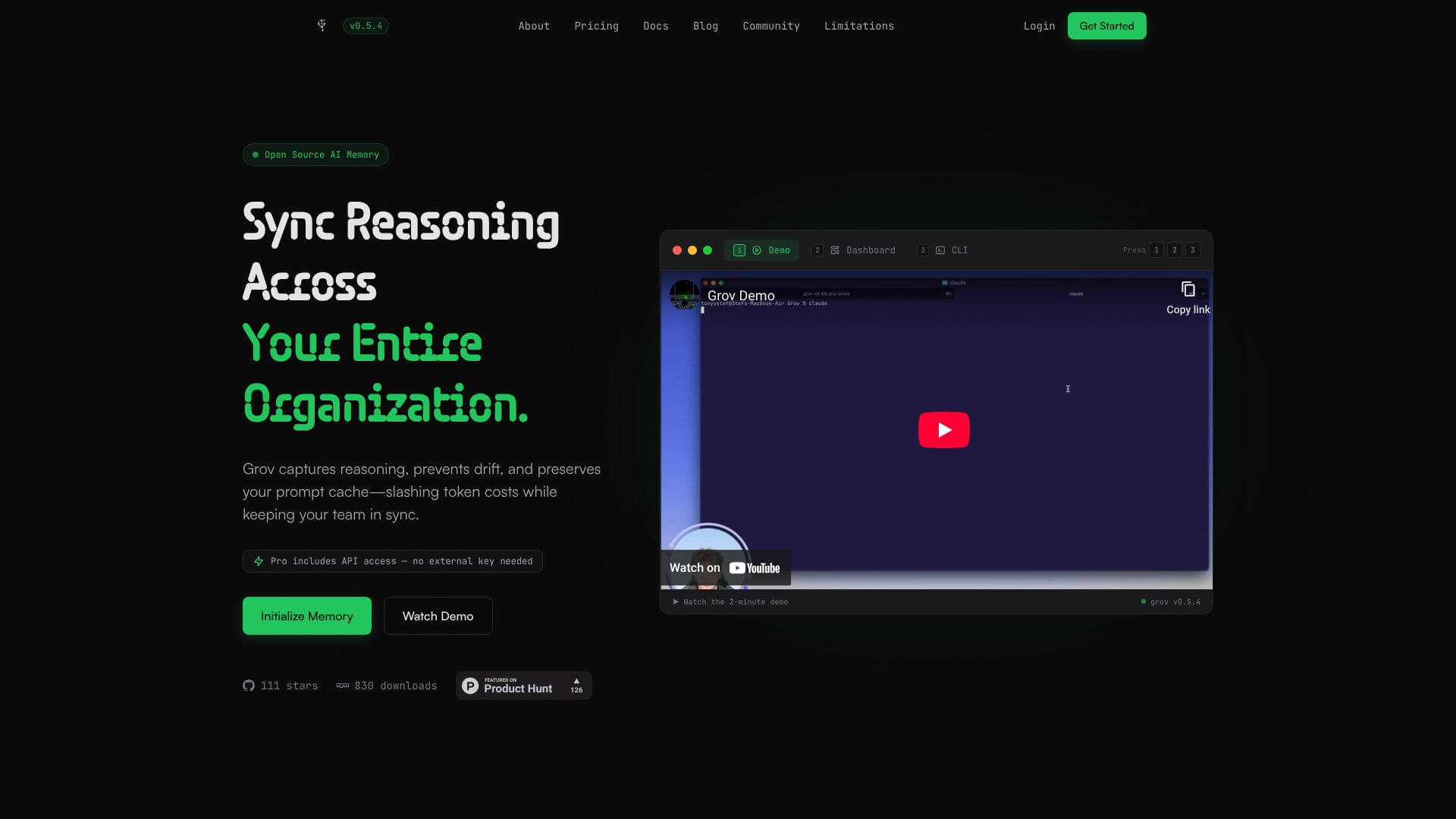
Grov is an AI Code tool. Grov helps engineering teams by giving AI coders a shared, ongoing memory for projects. Key features include Reasoning Trace Extraction, Persistent Local Storage, and Real-Time Drift Detection and Correction. Best for software developers and engineers.
About Grov
Grov sits between your AI coding assistant and your codebase, acting as a persistent memory layer that captures not just what the AI wrote but why. For teams using Claude Code, Cursor, Copilot, or similar agents across multiple sessions and developers, that institutional memory is usually what's missing.
The core problem Grov solves
AI coding agents start every session with amnesia. They re-explore your project structure, re-derive conventions, and re-make decisions that the team already made last week. Grov captures the reasoning behind code changes — the architectural choices, the rejected alternatives, the project-specific patterns — and feeds that context back to the AI on the next task.
How the pieces fit together
Grov runs locally and stores everything in SQLite on your machine, which means proprietary code and AI conversations never leave your environment. The drift detection layer compares new AI suggestions against your established project rules and flags inconsistencies before they land in a commit. Context injection works the opposite direction: when you start a new task, Grov retrieves relevant prior reasoning and primes the AI with it.
The token cost angle
Long-running AI sessions accumulate context that pushes against model token limits, and most teams pay per token. Grov compresses and summarizes the chat history as it grows, then clears stale context — so your AI keeps the useful knowledge but stops re-billing you for the same conversation. For engineering teams running AI assistants at scale, the savings compound quickly.
The platform is built for engineering teams who already use AI coding tools daily and want consistency across developers and sessions. It's less relevant if you're a solo developer using AI for occasional tasks, but for any team with two or more engineers sharing AI workflows, the shared memory model addresses a real pain point.
Key Features
Reasoning Trace Extraction.
Persistent Local Storage.
Real-Time Drift Detection and Correction.
Context Injection and Semantic Retrieval.
Token Cost Optimization.
Frequently Asked Questions
Grov is an open-source tool that helps engineering teams use AI more effectively for coding. It creates a shared memory for AI models like Claude Code, so they remember past decisions and project details.
Grov tracks the reasoning behind coding changes. If an AI proposes something that goes against previous decisions or project rules, Grov steps in. It reminds the AI of the established patterns to keep the code consistent.
The basic version of Grov is free because it's open-source. There's also a Pro version that adds features for team syncing, which might have a cost, but the core tool is free.
Grov runs locally on your computer and stores all its data in a local SQLite database. This means your sensitive code details and AI reasoning never leave your machine or go to external cloud services, unless you opt into the Pro version's cloud syncing.