
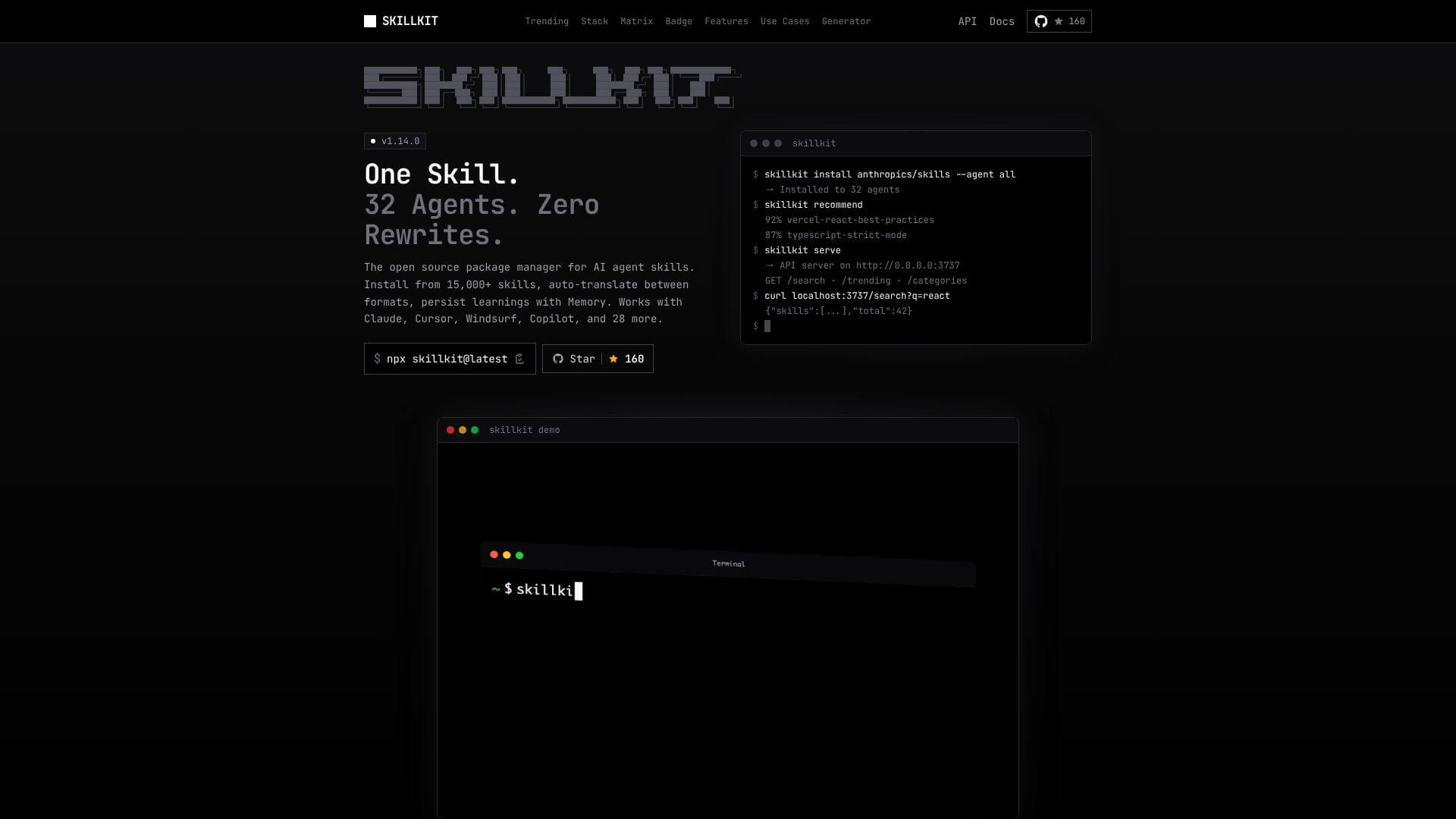
Skillkit is an AI Code tool. Manages, translates, and deploys AI coding agent skills across 32 platforms. Key features include Cross-Agent Translation (32 Supported Agents), Session Memory That Persists, and Multi-Agent Team Orchestration. Best for software developers and engineers, data scientists and analysts and project managers.
About Skillkit
Skillkit is an open-source universal skill management platform for AI coding agents that lets developers create skills once and use them across 32 different AI agents. The platform combines cross-agent translation with persistent session memory, multi-agent team orchestration, encrypted mesh networking, and AI-powered recommendations — targeting developers using multiple AI coding tools who'd otherwise rewrite skills for each.
The core features that matter
- Cross-agent translation across 32 supported agents including Claude Code, Cursor, Codex, and Copilot, converting skill specifications automatically
- Session memory that persists capturing what agents learn through specialized memory techniques, with searchable history and skill-conversion capability
- Multi-agent team orchestration creating organized teams of AI agents with role assignments, approval flows, and code review patterns
- Encrypted mesh network for distributed teams letting agents communicate securely across machines for team-based agent collaboration
- AI-powered intelligent recommendations analyzing project files to suggest appropriate skills automatically based on what your code actually needs
How it stands out
The AI coding tool ecosystem has many agents with proprietary skill formats — Claude Code uses CLAUDE.md, Cursor has its own conventions, Codex skills work differently, etc. Skillkit's specific position is the universal layer that lets one skill work across all of them. For developers actively using multiple AI coding tools, that translation removes substantial duplicate work.
The honest qualifier: cross-agent translation depends on agents actually exposing comparable functionality. Skillkit handles the standard skill patterns well but agent-specific advanced features may not translate cleanly. The 32-agent support is impressive but specific translation quality varies — popular targets (Claude Code, Cursor) likely work better than niche ones. For developers managing skills across multiple agents and wanting to maintain them in one place, Skillkit addresses real coordination overhead. For developers committed to one agent ecosystem, the translation layer adds complexity without proportional value.
Key Features
Cross-Agent Translation (32 Supported Agents).
Session Memory That Persists.
Multi-Agent Team Orchestration.
Encrypted Mesh Network for Distributed Teams.
AI-Powered Intelligent Recommendations.
Frequently Asked Questions
SkillKit is an open-source platform specifically for managing skills for AI coding agents. It was created by Rohit G to solve the problem of different AI agent platforms having incompatible skill formats. Instead of being another AI tool, SkillKit works as a middle layer. It sits between your skills and your agents, handling things like format translation and synchronization across many different agent systems.
SkillKit helps with skill development and deployment for AI agents in several ways. Its main job is cross-agent translation. This means you can write a skill once in any supported agent's format, and SkillKit will automatically translate it for other compatible agents. It also keeps a memory of agent interactions, so agents don't forget what they've learned between sessions. On top of that, SkillKit can coordinate teams of AI agents, letting them work together with assigned tasks and review processes.
This is SkillKit's main feature. It lets developers write a skill just once and use it across 32 different AI agents, including Claude Code, Cursor, Codex, and Copilot. These agents usually need skills in their specific formats. SkillKit solves this by converting skill specifications between these different formats, so you don't have to rewrite your skills multiple times.
Unlike typical AI models that forget everything after each interaction, SkillKit remembers what agents learn from their sessions. It uses semantic embeddings to store this learning. You can compress, search, and even export these historical learnings as new skills. This turns agents from simple assistants into systems that actually learn and get better over time.